
Palabras clave
Infecciones Fúngicas
Oncología
Neurocirugía
Cómo citar
Copyright © | Todos los derechos reservados.
La revista posee los derechos de autor exclusivos para la publicación de este artículo en los términos de la ley brasileña 9610/98.
Reproducción parcial
El uso de partes de los textos, figuras y cuestionario del artículo es libre, siendo obligatoria la citación de los autores y revista.
Reproducción total
Está expresamente prohibido y debe ser autorizado por la revista.
Resumen
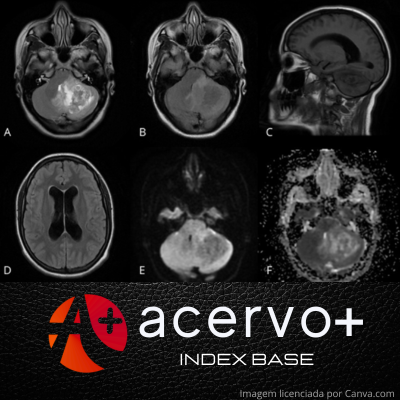
Objetivo: Reportar un caso raro de criptococoma cerebeloso que simulaba metástasis en una paciente oncológica, destacando la importancia del diagnóstico diferencial y del manejo adecuado de las infecciones fúngicas oportunistas. Descripción del caso: Mujer de 22 años, previamente inmunocompetente, diagnosticada con cáncer cervical, sometida a quimioterapia y radioterapia. Durante el tratamiento, desarrolló síntomas neurológicos, incluyendo cefalea y temblor en el miembro superior izquierdo. La resonancia magnética craneal reveló una lesión expansiva en el cerebelo con características sugestivas de metástasis, además de signos de hidrocefalia obstructiva. Se realizó una intervención quirúrgica con resección de la lesión. El examen histopatológico confirmó la presencia de Cryptococcus neoformans, estableciendo el diagnóstico de criptococoma cerebeloso. A pesar de su estado inmunológico previamente intacto, la paciente presentó inmunosupresión secundaria al tratamiento oncológico, lo que la predispuso a una infección fúngica. Se llevaron a cabo procedimientos adicionales, como la corrección de una fístula de líquido cefalorraquídeo y la derivación ventrículoperitoneal para el control de la hidrocefalia. Se inició tratamiento antifúngico con evolución clínica favorable. Consideraciones finales: Este caso resalta la importancia del diagnóstico diferencial de las lesiones cerebelosas en pacientes oncológicos, especialmente en situaciones en las que se sospecha fuertemente una metástasis. La identificación temprana y el manejo adecuado son fundamentales para prevenir complicaciones neurológicas graves y mejorar el pronóstico.
Referencias
BICANIC T, et al. Toxicity of Amphotericin B deoxycholate-based induction therapy in patients with HIV-associated cryptococcal meningitis. Antimicrob Agents Chemother, 2015; 59: 7224-31.
BRUNASSO L, et al. Seizure in isolated brain cryptococcoma: Case report and review of the literature. Surg Neurol Int, 2021; 12: 153.
CHANG SC, et al. Diffusion-weighted MRI features of brain abscess and cystic or necrotic brain tumors: comparison with conventional MRI. Clin Imaging, 2002; 26: 227-36.
DUARTE SBL, et al. Magnetic resonance imaging findings in central nervous system cryptococcosis: comparison between immunocompetent and immunocompromised patients. Radiol Bras, 2017; 50: 359-65.
GANGADHARAN SS, RAVEENDRANATH S. Cryptococcosis in oncology patients: a case series in a tertiary care cancer centre. Iran J Microbiol, 2023.
GAVITO-HIGUERA J, et al. Fungal infections of the central nervous system: A pictorial review. J Clin Imaging Sci, 2016; 6: 24.
KAMBUGU A, et al. Outcomes of cryptococcal meningitis in Uganda before and after the availability of highly active antiretroviral therapy. Clin Infect Dis, 2008; 46: 1694-701.
KAWAGUCHI T, et al. Successful treatment of disseminated cryptococcosis with liposomal amphotericin B and isavuconazole in an adult living with HIV: A case report and literature review. Journal of Infection and Chemotherapy, 2025; 31(1): 102534.
KLOCK C, et al. Histopathological aspects of neurocryptococcosis in HIV-infected patients: autopsy report of 45 patients. Int J Surg Pathol, 2009; 17: 444-8.
LI Y, et al. Microbiological, epidemiological, and clinical characteristics of patients with Cryptococcal meningitis at a tertiary hospital in China: A 6-year retrospective analysis. Frontiers in Microbiology, 2020; 11: 1837.
MACHADO M, et al. Criptococoma cerebral e pulmonar em paciente imunocompetente: relato de caso. Arquivos Brasileiros de Neurocirurgia Brazilian Neurosurgery, 2015; 34(4): 335-337.
MAY RC, et al. Cryptococcus: from environmental saprophyte to global pathogen. Nat Rev Microbiol, 2016; 14: 106-17.
MBANGIWA T, et al. Development and validation of quantitative PCR assays for HIV-associated cryptococcal meningitis in sub-Saharan Africa: a diagnostic accuracy study. The Lancet Microbe, 2024; 5(3): e261-e271.
OLIVEIRA EP, et al. Clinical and epidemiological characteristics of neurocryptococcosis associated with HIV in northeastern Brazil. Viruses, 2023; 15.
PAIVA ALC, et al. Cryptococcoma mimicking a brain tumor in an immunocompetent patient: case report of an extremely rare presentation. São Paulo Med J, 2018; 136: 492-6.
POLEY M, et al. Meningite criptocócica em um paciente aparentemente imunocompetente. J Investig Med High Impact Case Rep, v. 7, 2019.
ROCHA MF, et al. Reframing the clinical phenotype and management of cryptococcal meningitis. Pract Neurol, 2024; n-2024-004133.
SANTANDER XA, et al. Intraventricular cryptococcoma mimicking a neoplastic lesion in an immunocompetent patient with hydrocephalus: A case report. Surg Neurol Int, 2019; 10: 115.
SCHMALZLE SA, et al. Cryptococcus neoformans infection in malignancy. Mycoses, 2016; 59(9): 542-552.
SILLERO-FILHO VJ, et al. Cerebellar cryptococcoma simulating metastatic neoplasm. Arq Neuropsiquiatr, 2009; 67: 290-2.
TSENG H-K, et al. How Cryptococcus interacts with the blood-brain barrier. Future Microbiol, 2015; 10: 1669-82.
XIA S, LI X, LI H. Imaging characterization of cryptococcal meningoencephalitis. Radiol Infect Dis, 2016; 3: 187-91.
ZHANG J, et al. Antifungal susceptibility and molecular characteristics of Cryptococcus spp. based on whole-genome sequencing in Zhejiang Province, China. Front. Microbiol., 2022; 13: 991703.