
Palabras clave
Dolor de Espalda
Hernia Discal
Radiculopatía
Dolor lumbar
Cómo citar
Copyright © | Todos los derechos reservados.
La revista posee los derechos de autor exclusivos para la publicación de este artículo en los términos de la ley brasileña 9610/98.
Reproducción parcial
El uso de partes de los textos, figuras y cuestionario del artículo es libre, siendo obligatoria la citación de los autores y revista.
Reproducción total
Está expresamente prohibido y debe ser autorizado por la revista.
Resumen
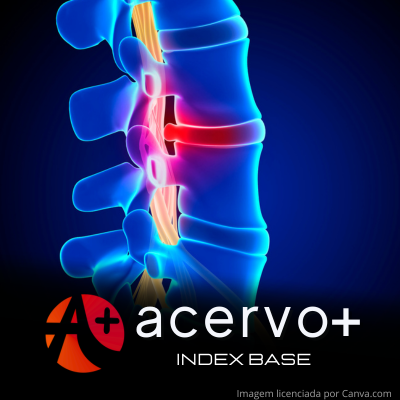
Objetivo: Describir la hernia de disco intervertebral, abordando su definición, epidemiología, etiología, manifestaciones clínicas, diagnóstico y abordajes terapéuticos actuales, con énfasis en innovaciones clínicas y quirúrgicas. Revisión bibliográfica: Esta revisión aborda la fisiopatología de la hernia discal, los factores de riesgo más prevalentes como la degeneración discal, la sobrecarga mecánica y los hábitos de vida, además de las presentaciones clínicas neurológicas y sus métodos de evaluación. La resonancia magnética se destaca como el examen de elección. El tratamiento conservador presenta altas tasas de éxito, mientras que el abordaje quirúrgico, especialmente el mínimamente invasivo, está indicado en casos refractarios. También se abordan técnicas emergentes como la cirugía endoscópica y las terapias regenerativas. Consideraciones finales: La hernia de disco intervertebral requiere un enfoque multidimensional basado en evidencias actualizadas, con énfasis en la estratificación clínica y el manejo individualizado. La incorporación de técnicas mínimamente invasivas y la creciente investigación en terapias regenerativas representan avances prometedores, aunque aún requieren validación a largo plazo.
Referencias
AIRAKSINEN O, et al. European guidelines for the management of chronic nonspecific low back pain. European Spine Journal, 2021; 30(6): 1234-1247.
AKINOLA M, et al. Endoscopic spine surgery: advances and emerging indications. World Neurosurgery, 2023; 176: 39-48.
ALTMANN C, et al. Lumbar disc herniation: importance of symptom duration for surgical decision-making. Deutsches Ärzteblatt International, 2024; 121(1): 26-32.
BATTIE MC e VIDEMAN T. Lumbar disc degeneration: epidemiology and genetics. Journal of Bone and Joint Surgery, 2006; 88(1): 9-14.
CHUNG TS, et al. Advances in minimally invasive spine surgery. Journal of Neurosurgical Spine, 2020; 32(4): 421-430.
CUNHA M, et al. Hérnia de disco e impactos previdenciários: análise de afastamentos no Brasil. Revista Brasileira de Medicina do Trabalho, 2024; 22(1): 15-22.
DESMOULIN GT, et al. Mechanical aspects of intervertebral disc injury and implications on biomechanics. The Spine Journal, 2019; 19(4): 724-734.
D'ORIA S, et al. Minimally invasive transforaminal interbody fusion versus microdiscectomy without fusion for recurrent lumbar disk herniation: a prospective comparative study. Journal of the American Academy of Orthopaedic Surgeons, 2023; 31(22): 1157-1164.
FARDON DF, et al. Lumbar disc nomenclature: version 2.0. Recommendations of the combined task forces of the NASS, ASNR, and ASSR. Spine Journal, 2014; 14(11): 2525-2545.
HINCAPIÉ CA, et al. Incidence of and risk factors for lumbar disc herniation with radiculopathy in adults: a systematic review. European Spine Journal, 2025; 34(1): 263-294.
JENSEN TS, et al. Diagnosis and classification of disc herniation: recommendations from the spine societies. European Spine Journal, 2022; 31(2): 123-137.
KAYASTHA A, et al. Lumbar disc herniation with radiculopathy: a comparison of NASS guidelines and ChatGPT. North American Spine Society Journal, 2024; 19: 100333.
KHAN N, et al. Clinical guidelines for the evaluation and treatment of lumbar disc herniations: how accurate is the internet? World Neurosurgery, 2023; 178: 682-691.
PAIVA WS, et al. Prevalência de hérnia de disco em pacientes com lombalgia aguda em hospital terciário. Coluna/Columna, 2017; 16(3): 226-229.
PARK DK, et al. Unilateral biportal endoscopy for lumbar spinal stenosis and lumbar disc herniation. JBJS Essential Surgical Techniques, 2023; 13(2): 22.00020.
RAJA A, et al. Low back pain and herniated disc: epidemiology, risk factors and diagnostic considerations. BMJ Open, 2020; 10(2): 34811.
SOUFI KH, et al. Potential role for stem cell regenerative therapy as a treatment for degenerative disc disease and low back pain: a systematic review. International Journal of Molecular Sciences, 2023; 24(10): 8893.
WANG F, et al. Regenerative medicine for the treatment of chronic low back pain: a narrative review. Journal of International Medical Research, 2023; 51(2): 3000605231155777.
WANG H, et al. Outcomes of percutaneous endoscopic lumbar discectomy: a meta-analysis. Orthopaedic Surgery, 2023; 15(1): 45-52.
YE F, et al. Regenerative medicine strategies for intervertebral disc degeneration. Stem Cells International, 2022; 1-12.
ZENG Z, et al. Prediction and mechanisms of spontaneous resorption in lumbar disc herniation: narrative review. Spine Surgery and Related Research, 2023; 8(3): 235-242.
ZHANG QX, et al. How to enhance the ability of mesenchymal stem cells to alleviate intervertebral disc degeneration. World Journal of Stem Cells, 2023; 15(11): 989-998.
ZHANG Y, et al. Stem cell-based therapies for intervertebral disc degeneration: clinical progress and challenges. Frontiers in Bioengineering and Biotechnology, 2022; 10: 897654.
ZOU T, et al. Incidence of spontaneous resorption of lumbar disc herniation: a meta-analysis. Clinical Spine Surgery, 2024; 37(6): 256-269.