
Keywords
Risk factors
Gastroesophageal diseases
How to Cite
Copyright © | All rights reserved.
The journal holds the exclusive copyright for the publication of this article under the terms of Brazilian law 9610/98.
Partial reproduction
The use of parts of the texts, figures and questionnaire of the article is free, being mandatory the citation of the authors and journal.
Total reproduction
It is expressly prohibited and must be authorized by the journal.
Abstract
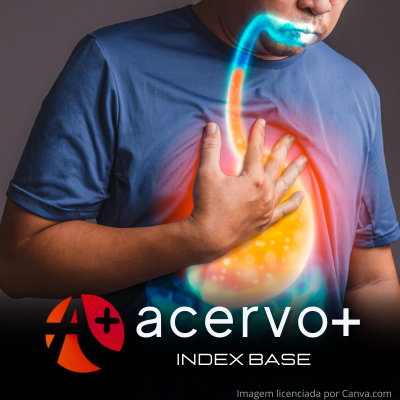
Objective: This study seeks to determine the prevalent risk factors for Gastroesophageal Reflux Disease in students at a university in the interior of the Amazon. Methods: This is a observational, descriptive and quantitative study carried out at the Universidade do Estado do Pará (UEPA) through an electronic questionnaire. Results: 183 responses were obtained. The prevalence was female (53.6%), mixed-race (58.46%), aged 18 to 20 years (45.35%). 38.3% are medicine students, 94% take full-time courses. Only 13.1% have a diagnosis of the disease. In relation to Body Mass Index (BMI), 25.68% are overweight and 6.01% are type I obese. 76% consume at least 1 cup of coffee per day, 60.7% consume alcohol socially and 3,3% smoke electronic cigarettes. 46% uses non-steroidal anti-inflammatory drugs (NSAIDs) every month and 38.8% has inadequate sleep. 32.8% do not practice physical exercise. The average of perceived stress was 22.3, and the female average (24.8) was higher. Conclusion: Insuficient sleep, consumption of alcoholic beverages and coffee and high stress levels are predominant risk factors for GERD in university students. New studies are needed to clarify the connection between the lifestyle of the students and the development of GERD.
References
AZZAM RS. Are the persistente symtoms to proton pump inhibitor therapy due to refractory gastroesophageal reflux disease or to other disorders?. Arquivos de gastroenterologia, 2018; 55: 85-91.
BINDU S, et al. “Non-steroidal anti-inflammatory drugs (NSAIDs) and organ damage: A current perspective.” Biochemical pharmacology, 2020; 180: 114-147.
BRASIL. Instituto Brasileiro De Geografia e Estatística (IBGE). Censo Brasileiro. 2022. Rio de Janeiro. 2023. Disponível em: https://censo2022.ibge.gov.br/pt/censo-2022-inicio.html?lang=pt-BR. Acessado em 05 de janeiro de 2024.
CHEN S, et al. Is alcohol consumption associated with gastroesophageal reflux disease? J Zhejiang Univ sci b, 2010; 11(6):423-8.
COHEN S, et al. Perceived Stress Scale. J Health Soc Behav, 1983; 24(4):385-96.
COHEN S. Contrasting the Hassles Scale and the Perceived Stress Scale: Who's really measuring appraised stress? American Psychologist, 1986; 41(6): 716–718.
CORONEL MA, et al. The efficacy of the different endoscopic treatments versus sham, pharmacologic or surgical methods for chronic gastroesophageal reflux disease: a systematic review and meta-analysis. Arq. gastroenterol, 2018; 55: 296-305.
EMILSSON OI, et al. Insufficient sleep and new onset of nocturnal gastroesophageal reflux among women: a longitudinal cohort study. J clin sleep med, 2022; 18(7):1731–1737.
FARO A. Análise fatorial confirmatória das três versões da Perceived Stress Scale (PSS): um estudo populacional. Psicologia: Reflexão e Crítica, 2015; 28(1): 21–30.
FRANKE A, et al. The effect of ethanol and alcoholic beverages on gastric emptying of solid meals in humans. Alcohol and alcoholism (Oxford, Oxfordshire), 2005; 40(3): 187–193.
FREITAS LM, et al. Estilos de vida associado a faixa etária de acadêmicos da Universidade Federal de Rondonópolis, MT. Biodiversidade, 2019; 18(1): 129-149.
GOLDMAN N, et al. Perceived stress and physiological dysregulation in older adults. Stress, 2005; 8(2): 95-105.
GONÇALVES ARN, et al. Doença do Refluxo Gastroesofágico: artigo de revisão. Revista Médica de Minas Gerais, 2005; 15(3): 192-5.
HALLAN A, et al. Risk factors on development of new-onset gastroesophageal reflux symptoms. A population-based prospective cohort study: The HUNT Study. Amer J Gastroenterol, 2015; 110: 393-400.
LEVY RL, et al. Psychosocial Aspects of the Functional. Gastrointestinal Disorders. Gastroenterology, 2006; 130: 1447–1458.
MARTINUCCI I, et al. Gastroesophageal reflux symptoms among Italian university students: epidemiology and dietary correlates using automatically recorded transactions. BMC Gastroenterol, 2018; 18(1): 116.
MEIRA ATS, et al. Clinical and endoscopic evaluation in patients with gastroesophageal symptoms. Arquivos De Gastroenterologia, 2019; 56(1): 51–54.
NEHLIG A. Effects of Coffee on the Gastro-Intestinal Tract: A Narrative Review and Literature Update. Nutrients, 2022; 14: 399.
NIRWAN JS, et al. Global prevalence and risk factors of gastro-oesophageal reflux disease (gord): systematic review with meta-analysis. Sci reports, 2020; 10: 5814-5826.
OGA S, et al. Fundamentos de toxicologia. 4nd ed. São Paulo: Atheneu, 2008; 704p.
OLADOSU FA, et al. Nonsteroidal antiinflammatory drug resistance in dysmenorrhea: epidemiology, causes, and treatment. American journal of obstetrics and gynecology, 2018; 218(4): 390–400.
ORGANIZAÇÃO MUNDIAL DE SAÚDE (OMS). Guidelines on physical activity and sedentary behaviour: at a glance. Genebra. 2020. Disponível em: https://www.who.int/publications/i/item/9789240015128. Acessado em 05 de janeiro de 2024.
PIRES AMFS, et al. Qualidade de Vida de Acadêmicos de Medicina: Há Mudanças durante a Graduação? Revista Brasileira De Educação Médica, 2020; 44 (4): e124.
REIS RS, PETROSKI EL. Relibity and validity of the Brazilian version of the perceived stress scale. Preventive Medicine (In Press), 2004; 15(1):107-14.
REMOR E. Psychometric properties of a European Spanish version of the Perceived Stress Scale (PSS). Spanish Journal of Psychology, 2006; 9(1): 86-93.
SAWAH MA, et al. Perceived Stress and Coffee and Energy Drink Consumption Predict Poor Sleep Quality in Podiatric Medical Students: A Cross-sectional Study. Journal of the American Podiatric Medical Association, 2015; 105(5): 429–434.
SCHEY R, et al. Sleep Deprivation Is Hyperalgesic in Patients With Gastroesophageal Reflux Disease. Gastroenterology, 2007; 133: 1787-95.
SOUSA CC, ARAÚJO TM. Qualidade de Vida de Acadêmicos de Medicina. Rev Bras Saude Ocup, 2024; 44(04): e124.
TARASZEWSKA A. Risk factors for gastroesophageal reflux disease symptoms related to lifestyle and diet. Roczniki Panstwowego Zakladu Higieny, 2021; 72(1): 21-28.
VIEIRA VCR, et al. Perfil socioeconômico, nutricional e de saúde de adolescentes recém-ingressos em uma universidade pública brasileira. Revista De Nutrição, 2002; 15(3): 273–282.
WADALLA NJ. Personal, academic and stress correlates of gastroesophageal reflux disease among college studentsin southwestern Saudi Arabia: A cross-section study, Annals of Medicine and Surgery; 2019; 47: 61-65.
WRIGHT CE, et al. O efeito do estresse psicológico na gravidade e percepção dos sintomas em pacientes com refluxo gastroesofágico. J Psicosom Res, 2005; 59: 415–424.
YUAN S, LARSSON SC. Adiposity, diabetes, lifestyle factors and risk of gastroesophageal reflux disease: a Mendelian randomization study. Eur J Epidemiol, 2022; 37: 747–754.
ZHENG Z, et al. Lifestyle factors and risk for symptomatic gastroesophageal reflux in monozygotic twins. Gastroenterol, 2007; 132: 87-95.