
Keywords
Temporomandibular disorder
Temporomandibular joint
Bruxism
How to Cite
Copyright © | All rights reserved.
The journal holds the exclusive copyright for the publication of this article under the terms of Brazilian law 9610/98.
Partial reproduction
The use of parts of the texts, figures and questionnaire of the article is free, being mandatory the citation of the authors and journal.
Total reproduction
It is expressly prohibited and must be authorized by the journal.
Abstract
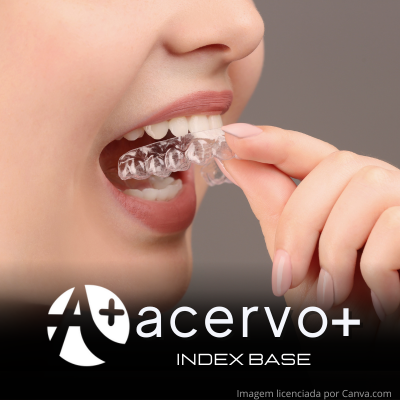
Objective: To analyze the progression of joint noises and pain in the temporomandibular joint, headaches, and muscle pain with the use of a rigid occlusal splint. Case details: Female patient, 21 years old, seen at a in private clinic in the city of Gurupi in the state of Tocantins, reporting clicking and pain in the left TMJ, headaches, and pain in the sternocleidomastoid and trapezius muscles. Imaging, electroencephalogram, and blood tests showed no direct correlation with the reported symptoms. The patient was already undergoing muscle physiotherapy, using essential oils, and taking 30mg of Duloxetine to manage stress and anxiety. Clinical examination revealed tongue indentation, posterior dental attrition, and bilateral linea alba on the buccal mucosa. During TMJ palpation, a double click (when opening and closing the mouth) was noted on the left TMJ. The recommended treatment included the use of a rigid occlusal splint, along with multidisciplinary support for better outcomes. Final considerations: The occlusal splint was crucial in the treatment, but the success was also attributed to a combination of medication therapy and adjustments in the patient’s habits, contributing to both physical and psychological improvements.
References
AGUIAR ASC. Placa miorrelaxante como medida paliativa ao agravo da dor orofacial associada às circunstâncias da pandemia da COVID-19. Revista Ibero-Americana de Humanidades, Ciências e Educação, 2022; 8(5): 373-382.
ALBAGIEH H, et al. Occlusal splints-types and effectiveness in temporomandibular disorder management. The Saudi Dental Journal, 2023; 35(1): 70-79.
CAMACHO GB, et al. Disfunção temporomandibular em adultos: estudo retrospectivo. BrJP, 2021; 4: 310-315.
CANDIDO LA, et al. Abordagem terapêutica para além da placa oclusal de bruxismo e disfunção temporomandibular: relato de caso clínico. Revista de Odontologia da UNESP, 2021; 49: 46-0.
CHANG CL, et al. Functional disorders of the temporomandibular joints: Internal derangement of the temporomandibular joint. The Kaohsiung journal of medical sciences, 2018; 34(4): 223-230.
COSTA DUTRA L, et al. Condição dentária de pacientes com disfunção temporomandibular. Revista de Salud Pública, 2023; 21: 376-380.
DA SILVA PLP, et al. Tratamento da Dor Orofacial (DOF) e Disfunção Temporomandibular (DTM). Cuidados em saúde bucal no Sistema Único de Saúde.(1a ed., pp. 259–271). Editora UFPB, 2021.
DE ARAÚJO CRUZ, et al. Disfunção temporomandibular: revisão sistematizada. Archives of Health investigation, 2020; 9(6): 570-575, 2020.
EL-HOMOSSANY MEMB, et al. Evaluation of Different Kinds Of Occlusal Splints Therapy in the Management of Myofascial Pain. Egyptian Dental Journal, 2018; 64: 1405-1420.
FERREIRA CLP, et al. Sinais e sintomas de desordem temporomandibular em mulheres e homens. In: codas. sociedade brasileira de Fonoaudiologia, 2016; 17-21.
GONÇALVES S, et al. Valeriana officinalis. Revista lusófona de ciências e tecnologias da saúde, 2006.
LOBBEZOO F, et al. International consensus on the assessment of bruxism: Report of a work in progress. Journal of oral rehabilitation, 2018; 45(11): 837-844.
MELO ACR, et al. Disfunção Temporomandibular e Dor Orofacial: classificação, epidemiologia, importância do diagnóstico e implicações para o Sistema Único de Saúde (SUS). DE CASTRO RD e BATISTA AUD. Evidências científicas e práticas clínicas odontológicas no âmbito do Sistema Único de Saúde. 1a ed. Editora UFPB, 2020; 323-46.
RODRÍGUEZ GMN. Eficácia das placas oclusais no tratamento das DTM articulares. 2023.
OHRBACH, et al. Diagnostic criteria for temporomandibular disorders: assessment instruments. Version 15May, 2016.
PEZZATTI LB. Eficácia do uso da placa oclusal no tratamento da disfunção temporomandibular: revisão de literatura. 2019.
POLUHA RL, et al. Temporomandibular joint disc displacement with reduction: a review of mechanisms and clinical presentation. Journal of applied oral science, 2019; 27: e20180433.
RODRIGUES JJC, et al. Efeitos farmacológicos do fitoterápico valeriana no tratamento da ansiedade e no distúrbio do sono. Brazilian Journal of Development, 2021, 7(4): 41827-41840.
SASSI FC, et al. Tratamento para disfunções temporomandibulares: uma revisão sistemática. Audiology-communication research, 2018; 23: e1871.
FILHO V, et al. Disfunção Temporomandibular (DTM): uma revisão de literatura de suas causas e tratamentos. 2024.
VIANA DC, et al. Diferentes placas de mordida na terapia oclusal. Research, Society and Development, 2022; 11(15): e124111536893.