
Palavras-chave
Carbamazepina
Relatos de casos
Como Citar
Copyright © | Todos os direitos reservados.
A revista detém os direitos autorais exclusivos de publicação deste artigo nos termos da lei 9610/98.
Reprodução parcial
É livre o uso de partes do texto, figuras e questionário do artigo, sendo obrigatória a citação dos autores e revista.
Reprodução total
É expressamente proibida, devendo ser autorizada pela revista.
Resumo
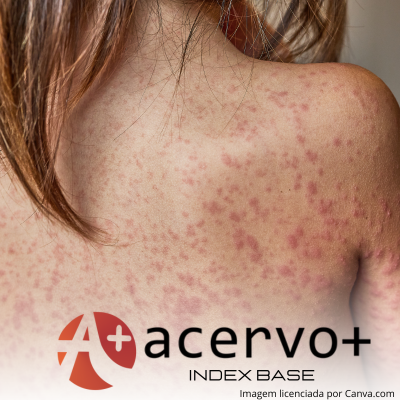
Objetivo: Descrever um relato de caso sobre a Síndrome de Reação a Drogas com Eosinofilia e Sintomas Sistêmicos (DRESS). Detalhamento de caso: Paciente masculino de 46 anos, anteriormente saudável, desenvolveu DRESS após o uso de carbamazepina para tratar neuralgia associada a herpes zoster. Após 40 dias de tratamento, ele apresentou erupções cutâneas, febre alta e linfadenopatia acentuada, sendo diagnosticado com DRESS no hospital. O tratamento imediato envolveu a suspensão da carbamazepina e a administração de hidrocortisona e prometazina, resultando em significativa melhora clínica e laboratorial do paciente. A equipe médica monitorou atentamente sua evolução, garantindo a adequação das intervenções. Considerações finais: A síndrome de DRESS, embora rara, representa uma condição clinicamente relevante devido a sua significativa morbimortalidade. Frequentemente, está associada ao uso de medicamentos diversos, mas também pode apresentar relação com agentes virais comuns, como o vírus Epstein-Barr e outros patógenos. O diagnóstico preciso dessa síndrome depende do reconhecimento dos critérios clínicos por parte dos profissionais de saúde, o que é fundamental para iniciar o tratamento apropriado e evitar complicações graves.
Referências
BOCQUET H, et al. Drug-induced pseudolymphoma and drug hypersensitivity syndrome (drug rash) with eosinophilia and systemic symptoms: DRESS. Semin Cutan Med Surg, 1996; 15(1): 250-257.
CALLE AM, et al. DRESS syndrome: A literature review and treatment algorithm. World Allergy Organ J, 2023; 16(3): 100673.
CARDONES AR. Drug reaction with eosinophilia and systemic symptoms (DRESS) syndrome. Clin Dermatol, 2020; 38(6): 702-711.
CHAPMAN S, et al. Apremilast-associated drug reaction with eosinophilia and systemic symptoms. Journal of the American Academy of Dermatology Case Reports, 2020; 6(4): 302-304.
CHHITI S, et al. DRESS syndrome with carbamazepine and Epstein–Barr virus reactivation. Our Dermatol Online, 2023; 14(1): 92-94.
DENG L, et al. Financial Burden and Health Care Utilization of Drug Reaction with Eosinophilia and Systemic Symptoms (DRESS): A Comprehensive Review. Journal of Health Economics, 2023; 85(1): 102578.
HAMA N, et al. Drug-Induced Hypersensitivity Syndrome (DIHS) / Drug Reaction With Eosinophilia and Systemic Symptoms (DRESS): Clinical Features and Pathogenesis. J Allergy Clin Immunol Pract, 2022; 10(5): 1155-1167.
HSU CY, et al. Psychological Impact and Quality of Life in Patients with DRESS Syndrome: A Longitudinal Study. Journal of Psychosomatic Research, 2021; 144(10): 110415.
KARDAUN SH, et al. Variability in the clinical pattern of cutaneous side-effects of drugs with systemic symptoms: does a DRESS syndrome really exist. Br J Dermatol, 2007; 156(12): 609–11.
MIYAGAWA F e ASADA H. Current Perspective Regarding the Immunopathogenesis of Drug-Induced Hypersensitivity Syndrome/Drug Reaction with Eosinophilia and Systemic Symptoms (DIHS/DRESS). Int J Mol Sci, 2021; 22(4): 2147.
MIYAGAWA F, et al. Correlation between Expression of CD134, a Human Herpesvirus 6 Cellular Receptor, on CD4+ T cells and Th2-type Immune Responses in Drug-induced Hypersensitivity Syndrome. Acta Derm. Venereol, 2020; 100(6): 5724.
PHILLIPS EJ, et al. Controversies in drug allergy: Testing for delayed reactions. J Allergy Clin Immunol, 2019; 143(1): 66 – 73.
PINTO LS, et al. Drug Reaction with Eosinophilia and Systemic Symptoms associada ao Alopurinol: um relato de caso. Acervo Saúde, 2020; 12(10): 4702.
RAMIREZ GA, et al. Drug Reaction with Eosinophilia and Systemic Symptoms (DRESS): Focus on the Pathophysiological and Diagnostic Role of Viruses. Microorganisms, 2023, 11(2): 346.
RODRÍGUEZ M, et al. DRESS syndrome secondary to carbamazepine. Rev Esp Enferm Dig, 2023; 115(2): 96-97.
SAPER VE, et al. Severe delayed hypersensitivity reactions to IL-1 and IL-6 inhibitors link to common HLA-DRB1*15 alleles. Ann Rheum Dis, 2022; 81(3): 406-415.
SCHUNKERT EM e DIVITO SJ. Updates and Insights in the Diagnosis and Management of DRESS Syndrome. Curr Dermatol Rep, 2021; 10(4): 192-204.
SCHWARTZ RA, et al. Drug Reaction with Eosinophilia and Systemic Symptoms (DRESS) Syndrome: An Update on Clinical Management and Economic Impact. Journal of Clinical Dermatology, 2022; 35(4): 455-467.
SHARMA A, et al. Carbamazepine-associated Drug Reaction with Eosinophilia and Systemic Symptoms Syndrome. J Pediatr Neurosci, 2021; 16(1): 55-57.
SHIOHARA T, et al. The diagnosis of a DRESS syndrome has been sufficiently established on the basis of typical clinical fea-tures and viral reactivations. Br J Dermatol, 2007; 156(5): 1083–1084.
VRINCEANU D, et al. Severe DRESS syndrome after carbamazepine intake in a case with multiple addictions: A case report. Exp Ther Med, 2020; 20(3): 2377-2380.