
Palavras-chave
Fissura labiopalatina
Alimentação
Neonatologia
Como Citar
Copyright © | Todos os direitos reservados.
A revista detém os direitos autorais exclusivos de publicação deste artigo nos termos da lei 9610/98.
Reprodução parcial
É livre o uso de partes do texto, figuras e questionário do artigo, sendo obrigatória a citação dos autores e revista.
Reprodução total
É expressamente proibida, devendo ser autorizada pela revista.
Resumo
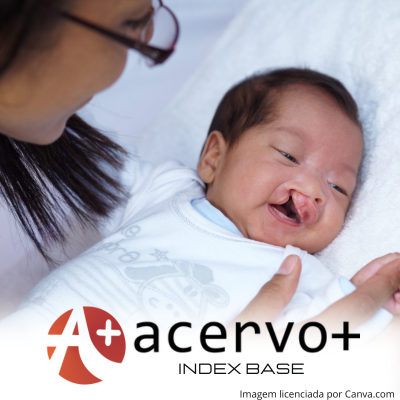
Objetivo: Avaliar o conhecimento da equipe interdisciplinar de saúde da neonatologia de um hospital de referência acerca dos cuidados com a alimentação de recém-nascidos com fissura labiopalatina. Métodos: Estudo exploratório, descritivo e transversal, com abordagem quantitativa, desenvolvido com 210 profissionais de saúde do setor de neonatologia da instituição por meio da aplicação de um questionário. Resultados: A principal dúvida dos profissionais foi relacionada à possibilidade de amamentação em seio materno. A maioria reconheceu a posição semi-sentada como ideal para alimentar o recém-nascido e indicou a mamadeira como utensílio mais seguro, contudo, muitos afirmaram não saber ajustar o bico, bem como desconheciam manobras de facilitação da alimentação. Conclusão: Os achados revelam lacunas importantes no conhecimento da equipe interdisciplinar, especialmente quanto às técnicas de alimentação e uso de utensílios adequados. Logo, a implementação de programas de capacitação e educação continuada da equipe são essenciais para garantir práticas seguras e baseadas em evidências no cuidado com o recém-nascido com fissura labiopalatina.
Referências
ACHMAD H, et al. Nutritional improvement in children with cieft llp and cleft palate using a combination of an obturator and feeding bottle infant. Journal of Pharmaceutical. Negative Results, 2022; 13 (8).
ADEKUNLE AA, et al. Breastfeeding practices among mothers of children with orofacial clefts in an african cohort. Cleft Palate Craniofacial Journal, 2020; 57 (8): 1018-1023.
AL-LAMI HA, et al. Presurgical management trends and nasoalveolar molding usage for infants with cleft lip and palate in the capital of a developing country. Journal Orthodontics Science, 2024; 16 (13): 4.
BABAI I. Orofacial Clefts: Genetics of Cleft Lip and Palate. Genes, 2023; 14 (8): 1603.
BATISTA NT, et al. Factors associated with breastfeeding adherence in infants with orofacial clefts: a scoping review. Cogitare Enfermagem, 2024; 29.
CAMPOS CJG, SAIDEL MGB. Amostragem em investigações qualitativas: conceitos e aplicações ao campo da saúde. Revista Pesquisa Qualitativa, 2022; 10 (25): 1-21.
CERÓN-ZAPATA AM, et al. Maternal perception of breastfeeding in children with unilateral cleft lip and palate: a qualitative interpretative analysis. International Breastfeed Journal, 2022; 54: 571-581.
DENADAI R, LO LJ. Reducing delayed detection of isolated cleft palate-related deformity: a call for routine intraoral examination of newborns. Journal Pediatric, 2024; 24.
DUDDING T, et al. An introduction to the UK care pathway for children born with a cleft of the lip and/or palate. British Dental Journal, 2023; 234 (12): 943–946.
DUSINGIZIMANA T, et al. A qualitative analysis of infant and young child feeding practices in rural Rwanda. Public Health Nutrition, 2021;24(12):3592-601.
GÁRATE KMS, et al. Types of feeding and presence of harmful oral habits in children with cleft lip and/or palate: a pilot study. Pesquisas Brasileiras de Odontopediatria Clínica Integrada, 2020; 20: e0063.
HEYDARI MH, et al. Prevalence, trend, and associated risk factors for cleft lip with/without cleft palate: a national study on live births from 2016 to 2021. BMC Oral Health, 2024; 24 (1): 36.
HOOKWAY L, et al. The challenges of medically complex breastfed children and their families: a systematic review. Maternal and Child Nutrition, 2021; 17(4): e13182.
JARA M, et al. Breastfeeding and factors associated to feeding in babies with cleft palate. International Journal Medical Science, 2020; 7 (4): 1-10.
KASSIM MJN, et al. Consulta de enfermagem a pacientes com fissuras labiopalatais. Revista Eletrônica Acervo Saúde, 2021; 13 (4): e6992.
LIGOT FAC, et al. A qualitative study on the feeding methods of Filipino mothers of children with cleft lip and palate aged 0–24 months: a pilot study. Acta Medical Philippina, 2024; 58 (3): 23–33.
LOPEZ-BASSOLS I, et al. Assisted Nursing: a case study of an infant with a complete unilateral cleft lip and palate. Journal Human Lactation, 2021; 37 (2): 419-424.
LUYO-PEÑAFIEL BR, et al. Sociodemographic Factors Associated with Knowledge About Management of Cleft Lip and Palate Patients in Peruvian Dental Students: A Logistic Regression Analysis. Advances in Medical Education and Practice, 2023; 14: 1287-1298.
MADHOUN LL, et al. Breast milk feeding practices and barriers and supports experienced by mother–infant dyads with cleft lip and/or palate. The Cleft Palate-Craniofacial Journal, 2020; 57 (4): 477-486.
MAIA ALRB, et al. O lábio leporino: uma revisão de literatura. Medicina: Égide do bem estar populacional, 2020; 129-140.
MATTOS ELM, et al. Métodos utilizados no aleitamento materno em recém-nascidos portadores de fissura lábio palatina: revisão de literatura. Revista Foco, 2023; 16 (12): e3839.
MCWILLIAMS D, et al. "It's On Your Shoulders Now" Transitioning from Child-to-Adult UK Cleft Lip/Palate Services: An Exploration of Young Adults' Narratives. Cleft Palate Craniofacial Journal, 2024; 62 (6): 1039-1052.
MIRANDA-FILHO AEF, et al. Do orofacial clefts impair breastfeeding and increase the prevalence of anemia? Cleft Palate Craniofacial Journal, 2021; 60 (1): 63-68.
MORETTO MJ, et al. Tratamento multidisciplinar na reabilitação de pacientes portadores de fissura de lábio e/ou palato. Journal of Multidisciplinary Dentistry, 2020; 10 (1): 3-8.
MORI MM, et al. Vivências maternas durante a amamentação de filhos com fissura labiopalatina. Ciências Práxis, 2024;19(34):20-34.
NABATANZI M, et al. “Mine did not breastfeed”, mothers’ experiences in breastfeeding children aged 0 to 24 months with oral clefts in Uganda. BMC Pregnancy and Childbirth, 2021; 21 (100): 1-9.
OLIVEIRA LB, et al. Breastfeeding and cleft lip and palate: a systematic review and meta-analysis. Cleft Palate Craniofacial Journal, 2023; (20):10556656231170137.
OMS. Organização Mundial da Saúde. 2022. Disponível em: https://www.who.int/news-room/fact-sheets/detail/oral-health. Acessado em: 03 de setembro de 2025
PENNY C, et al. A Systematic Review of Feeding Interventions for Infants with Cleft Palate. Cleft Palate Craniofacial Journal, 2022; 59(12):1527-1536.
PUTRI FA, et al. As ocorrências globais de fissura labiopalatina em pacientes pediátricos e sua associação com fatores demográficos: uma revisão narrativa. Children, 2024; 11(3): 322.
ROESSING AB, et al. Unilateral Cleft lip and Palate: Long-Term Results of the Malek Technique. Cleft Palate Craniofacial Journal, 2024; 61(2): 219-230.
SANTOS EAMC, OLIVEIRA TM. Conhecimentos atuais em Fissuras Labiopalatinas: uma revisão narrativa. Revista Eletrônica Acervo Saúde, 2021; 3(2): e5870.
SILVEIRA AKG, et al. Estudo para detecção de fissuras labiopalatinas no pré-natal: revisão de literatura e relato de caso. Brazilian Applied Science Review, 2020; 6 (4): 3959-3975.
WU W, et al. Status de crescimento físico e métodos de alimentação de bebês chineses com lábio leporino com ou sem fenda palatina com menos de 1 ano de idade. Revista Brasileira de Pediatria, 2020; 8: 194.
ZHU Y, et al. Prevalence of cleft lip and/or cleft palate in Guangdong province, China, 2015-2018: a spatio-temporal descriptive analysis. BMJ Open, 2021; 11(8): e046430.