
Keywords
Intensive Care Units
Pressure Injury
How to Cite
Copyright © | All rights reserved.
The journal holds the exclusive copyright for the publication of this article under the terms of Brazilian law 9610/98.
Partial reproduction
The use of parts of the texts, figures and questionnaire of the article is free, being mandatory the citation of the authors and journal.
Total reproduction
It is expressly prohibited and must be authorized by the journal.
Abstract
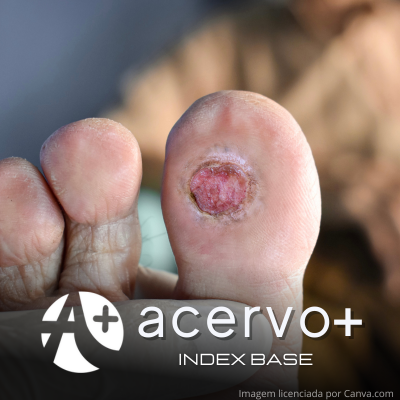
Objective: To identify the clinical profile of patients with COVID-19 who were affected by pressure injuries during hospitalization in the ICU of a public hospital in the Federal District. Methods: This is a cross-sectional, descriptive, retrospective study, based on secondary data. The population consisted of patients admitted to the ICU who developed pressure injuries, with laboratory confirmation for Covid-19, from March to December 2020. Demographic and clinical variables were analyzed. Results: 41 patients diagnosed with Covid-19 who developed pressure injuries were included. The majority were male (61%), with an average age of 59.90 years. There was a very high risk of developing pressure injuries (90.2%). The average length of stay was greater than 30 days, pressure injuries appeared in an average of 2.63 weeks, affected the sacral region more (70.7%) and stage 2 prevailed (63.4%). The main outcome was death in 53.7% of patients. Conclusion: During the study, it was found that care for patients with Covid-19 is complex, due to the clinical and hemodynamic instability of patients, which contribute to the emergence of pressure injuries.
References
ALDERDEN J, et al. Risk factors for pressure injuries among critical-care patients: A systematic review. Int J Nurs Stud, 2017; 71: 97–114.
Associação Brasileira de Estomaterapia - SOBEST e da Associação Brasileira de Enfermagem em Dermatologia- SOBENDE. Classificação das Lesões Por Pressão – CONSENSO NPUAP 2016 - adaptado culturalmente para o Brasil. 2016. Disponível em:<https://sobest.com.br/wp-content/uploads/2020/10/CONSENSO-NPUAP-2016_traducao-SOBEST-SOBENDE.pdf. Acessado em: 13 de dezembro de 2023.
BARBOSA IEB, et al. Segurança do paciente: principais eventos adversos na Unidade Terapia Intensiva. Revista Eletrônica Acervo Saúde, 2021; 13(2): e6454.
BARCELOS RA, TAVARES DMS. Fatores associados aos incidentes de segurança entre idosos em terapia intensiva. Acta Paulista de Enfermagem, 2017; 30(2): 159–167.
BLY D, et al. A Model of Pressure, Oxygenation, and Perfusion Risk Factors for Pressure Ulcers in the Intensive Care Unit. Am J Crit Care, 2016; 25(2):156-64.
BRASIL. Agência Nacional de Vigilância Sanitária (ANVISA). NOTA TÉCNICA GVIMS/GGTES/Anvisa no 05/2023(1° Versão atualizada da NOTA TÉCNICA GVIMS/GGTES Nº 03/2017). Assunto: Práticas de Segurança do Paciente em Serviços de Saúde: Prevenção de Lesão por Pressão. 2023. Disponível em: https://www.gov.br/anvisa/pt-br/centraisdeconteudo/publicacoes/servicosdesaude/notas-tecnicas/notas-tecnicas-vigentes/nota-tecnica-gvims-ggtes-anvisa-no-05-2023-praticas-de-seguranca-do-paciente-em-servicos-de-saude-prevencao-de-lesao-por-pressao/view. Acessado em: 02 de dezembro de 2023.
BRASIL. Ministério da Saúde. Protocolo de manejo clínico da Covid-19 na atenção especializada. 2020. Disponível em: https://pesquisa.bvsalud.org/bvsms/resource/pt/biblio-1096764. Acessado em: 29 de novembro 2023.
CHEN N, et al. Epidemiological and clinical characteristics of 99 cases of 2019 novel coronavirus pneumonia in Wuhan, China: a descriptive study. Lancet, 2020; 395(10223):507-513.
CHEN Y, et al. Aging in COVID-19: Vulnerability, immunity and intervention. Ageing Res Rev, 2021; 65:101205.
COSTA IG, CALIRI MHL. Validade preditiva da escala de Braden para pacientes de terapia intensiva. Acta Paulista de Enfermagem, 2011; 24(6): 772 – 777.
COSTA LP, et al. Fatores de risco para lesão por pressão em pacientes com COVID-19 em unidade de terapia intensiva. Rev. Pesqui., 2022; 14:e11787.
COX J, et al. Pressure Injury Risk Factors in Critical Care Patients: A Descriptive Analysis. Adv Skin Wound Care, 2018; 31(7):328-334.
GALVÃO MHR, RONCALLI AG. Fatores associados a maior risco de ocorrência de óbito por COVID-19: análise de sobrevivência com base em casos confirmados. Revista Brasileira de Epidemiologia, 2020; 23: e200106.
GOIÁS. Subsecretaria de Saúde. Gerência de Informações Estratégicas em Saúde.Covid-19: evolução e manejo clínico. Conecta-sus. 2021. Disponível em: https://pesquisa.bvsalud.org/portal/resource/pt/biblio-1284117. Acessado em: 10 de dezembro de 2023.
GUÉRIN C et al. Prone position in ARDS patients: why, when, how and for whom. Intensive Care Med, 2020; 46(12):2385-2396.
GUÉRIN C, et al. Prone positioning in severe acute respiratory distress syndrome. N Engl J Med, 2013; 368(23):2159-2168.
HOLANDA MA e PINHEIRO BV. Pandemia por COVID-19 e ventilação mecânica: enfrentando o presente, desenhando o futuro. J Bras Pneumol, 2020; 46(4):e20200282.
HUANG C, et al. Clinical features of patients infected with 2019 novel coronavirus in Wuhan, China. Lancet, 2020;395(10223):497-506.
INSTITUTO BRASILEIRO DE GEOGRAFIA E ESTATÍSTICA (IBGE). Censo Demográfico 2022: Identificação étnico-racial da população, por sexo e idade: Resultados do universo. 2023. Disponível em: https://censo2022.ibge.gov.br/panorama/?utm_source=ibge&utm_medium=home&utm_campaign=portal. Acessado em: 04 de janeiro de 2024.
JANSEN RCS et al. Braden Scale in pressure ulcer risk assessment. Revista Brasileira de Enfermagem, 2020; 73(6): e20190413.
LABEAU SO, et al. Prevalence, associated factors and outcomes of pressure injuries in adult intensive care unit patients: the DecubICUs study. Intensive Care Med, 2021;47(2):160-169.
LI LQ, et al. COVID‐19 patients' clinical characteristics, discharge rate, and fatality rate of meta‐analysis. J Med Virol, 2020; 92(6): 577–583.
LIMA SERRANO M, et al. Risk factors for pressure ulcer development in Intensive Care Units: A systematic review. Med Intensiva, 2017; 41(6):339-346.
MELO CM, et al. Lesão por Pressão em Unidade de Terapia Intensiva: prevalência e fatores associados em pacientes com COVID-19. Revista Gaúcha de Enfermagem, 2023; 44: e20210345.
MOORE Z, et al. Prevention of pressure ulcers among individuals cared for in the prone position: lessons for the COVID-19 emergency. J Wound Care, 2020; 29(6):312-320.
OLIVEIRA MAL, et al. Testes Diagnósticos para o SARS-COV-2: uma reflexão crítica. Química Nova, 2022; 45(6): 760 – 766.
OTTO C, et al. Fatores de risco para o desenvolvimento de lesão por pressão em pacientes críticos. Enferm. Foco, 2019; 10(1):07-11.
PACHÁ HHP, et al. Lesão por Pressão em Unidade de Terapia Intensiva: estudo de caso-controle. Revista Brasileira de Enfermagem, 2018; 71(6): 3027 – 3034.
PEREIRA EF. A pandemia de Covid-19 na UTI. Horiz. antropol.,2021; 27(59):49-70.
RANZANI OT, et al. Characterisation of the first 250,000 hospital admissions for COVID-19 in Brazil: a retrospective analysis of nationwide data. Lancet Respir Med, 2021; 9(4):407-418.
SILVA CPC, et al. Construção do Aplicativo para o indicador de úlcera por pressão. Journal Health Informatics, 2016, 8(4): 134-141.
WANG L, et al. Review of the 2019 novel coronavirus (SARS-CoV-2) based on current evidence. Int J Antimicrob Agents, 2020; 55(6):105948.
YANG X et al., 2020. Clinical course and outcomes of critically ill patients with SARS-CoV-2 pneumonia in Wuhan, China: a single-centered, retrospective, observational study. Lancet Respir Med, 2020; 8(5): 475–481.
YU N, et al. Pressure injury: A non-negligible comorbidity for critical Covid-19 patients. J Plast Reconstr Aesthet Surg, 2021; 74(3): 644-710.
ZHU N, et al. A novel coronavirus from patients with pneumonia in China, 2019. N Engl J Med, 2020; 382(8):727-733.