
Keywords
Steatosis
Cirrhosis
How to Cite
Copyright © | All rights reserved.
The journal holds the exclusive copyright for the publication of this article under the terms of Brazilian law 9610/98.
Partial reproduction
The use of parts of the texts, figures and questionnaire of the article is free, being mandatory the citation of the authors and journal.
Total reproduction
It is expressly prohibited and must be authorized by the journal.
Abstract
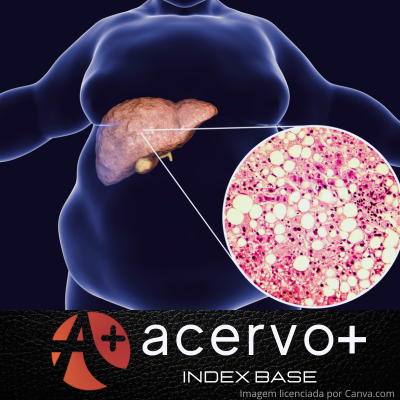
Objective: To understand the relationship between childhood obesity and Nonalcoholic fatty liver disease (DHGNA), by gathering content that expands the theme of this review. Methods: This is an integrative review, based on the PubMed and SCIELO research platform, using the descriptors "Childhood obesity" and "Non-alcoholic fatty liver disease" and "steatosis" and the Boolean operator “AND” and “OR”, with articles published from 2018 to 2024, in English, that were more relevant and current. In the total analysis, 10 articles were counted to be included as the basis of this. Results: DHGNA in children and adolescents is a complex pathogenesis, in which there are multifactorial predispositions that can alter lipid and sugar metabolism in the liver. It is underdiagnosed and children with obesity, hypertension, insulin resistance, diabetes, pre-diabetes, central adiposity and dyslipidemia should be screened. Early diagnosis and management will be the only way to tackle the disease. Changing lifestyle remains the cornerstone of treatment for DHGNA. Final considerations: Long-term studies are suggested to improve diagnosis and drug intervention, in order to have greater health promotion for children and impact on adult life.
References
ALBERTI G, et al. Relation between Body Composition Trajectories from Childhood to Adolescence and Nonalcoholic Fatty Liver Disease Risk. Nutrients, 2024; 16(6): 785.
BRUNNER KT, et al. Nonalcoholic fatty liver disease and obesity treatment. Current obesity reports, 2019; 8(3): 220-228.
CHACÓN C, et al. Clinical epidemiology of non-alcoholic fatty liver disease in children and adolescents. The LiverKids: Study protocol. Plos one, 2023; 18(10): 0286586.
CUZMAR V, et al. Early obesity: risk factor for fatty liver disease. Journal of Pediatric Gastroenterology and Nutrition, 2020; 70(1): 93-98.
DISTEFANO JK e SHAIBI GQ. The relationship between excessive dietary fructose consumption and paediatric fatty liver disease. Pediatric obesity, 2021; 16(6): 12759.
DRAIJER L, et al. A natural history study of paediatric non-alcoholic fatty liver disease over 10 years. JHEP Reports, 2023; 5(5): 100685.
FANG YAN-LAN, et al. Pathogenesis of non-alcoholic fatty liver disease in children and adolescence: From “two hit theory” to “multiple hit model”. World journal of gastroenterology, 2018; 24(27): 2974-2983.
FERREIRA S, et al. Nonalcoholic fatty liver disease and continuous metabolic syndrome in adolescents with overweight/obesity. Acta Medica Portuguesa, 2024; 37(3): 177-186.
GARIBAY-NIETO N, et al. Metabolomic Phenotype of Hepatic Steatosis and Fibrosis in Mexican Children Living with Obesity. Medicina, 2023; 59(10): 1785.
GOLDNER D e LAVINE JE. Nonalcoholic fatty liver disease in children: unique considerations and challenges. Gastroenterology, 2020; 158(7): 1967-19831.
HASHEM A, et al. Management of obesity and nonalcoholic fatty liver disease: A literature review. In: Seminars in liver disease. 333 Seventh Avenue, 18th Floor, New York, NY 10001, USA: Thieme Medical Publishers, Inc, 2021; 41(4): 435-447.
KARAIVAZOGLOU K, et al. Psychosocial issues in pediatric nonalcoholic fatty liver disease. Psychosomatics, 2019; 60(1): 10-17.
KO JS. New perspectives in pediatric nonalcoholic fatty liver disease: epidemiology, genetics, diagnosis, and natural history. Pediatric Gastroenterology, Hepatology & Nutrition, 2019; 22(6): 501-510.
LIN CHUAN-HAO e KOHLI R. Emerging new diagnostic modalities and therapies of nonalcoholic fatty liver disease. Current Gastroenterology Reports, 2020; 22(10): 52.
MARUSZCZAK K, et al. Determinants of hyperglucagonemia in pediatric non-alcoholic fatty liver disease. Frontiers in Endocrinology, 2022; 13: 1004128.
MAZHAR K. The future of nonalcoholic fatty liver disease treatment. Medical Clinics, 2019; 103(1): 57-69.
MOGAHED EA, et al. Causes of secondary non-alcoholic fatty liver disease in non-obese children below 10 years. European journal of pediatrics, 2020; 179(5): 719-726.
NERI CR, et al. Liver steatosis: a marker of metabolic risk in children. International Journal of Molecular Sciences, 2022; 23(9): 4822.
NEWTON KP, et al. Incidence of type 2 diabetes in children with nonalcoholic fatty liver disease. Clinical Gastroenterology and Hepatology, 2023; 21(5): 1261-1270.
POLYZOS SA, et al. Obesity and nonalcoholic fatty liver disease: From pathophysiology to therapeutics. Metabolism, 2019; 92: 82-97.
QUERTER I, et al. Maternal and perinatal risk factors for pediatric nonalcoholic fatty liver disease: a systematic review. Clinical Gastroenterology and Hepatology, 2022; 20(4): 740-755.
SMITH SK e PERITO ER. Nonalcoholic liver disease in children and adolescents. Clinics in liver disease, 2018; 22(4): 723-733.
SPIEZIA C, et al. Nutritional Approaches in Children with Overweight or Obesity and Hepatic Steatosis. Nutrients, 2023; 15(11): 2435.
ZHANG PING-PING, et al. Lifestyle intervention in children with obesity and nonalcoholic fatty liver disease (NAFLD): study protocol for a randomized controlled trial in Ningbo city (the SCIENT study). Trials, 2024, 25(1): 196.