
Keywords
Primary health care
Longitudinal studies
Poverty areas
How to Cite
Copyright © | All rights reserved.
The journal holds the exclusive copyright for the publication of this article under the terms of Brazilian law 9610/98.
Partial reproduction
The use of parts of the texts, figures and questionnaire of the article is free, being mandatory the citation of the authors and journal.
Total reproduction
It is expressly prohibited and must be authorized by the journal.
Abstract
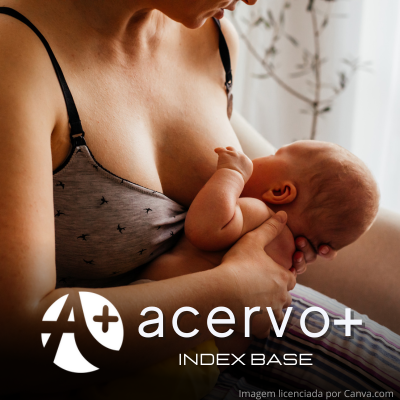
Objective: To describe the practice of exclusive breastfeeding (EBF) in children assisted by the Family Health Strategy of Maceió/AL. Methods: A population-based, prospective cohort-based, observational study in which mother / child binomials were followed fortnightly for up to six months or until EBF was discontinued. In the first and last visit, separate questionnaires were applied to the data records, which were analyzed in the Stata 12.1 program, and the frequency distribution tables were initially obtained for the categorical variables. The EBF duration curve was obtained using the Kaplan Meier procedure (survival curve). Results: 225 pairs of mother / child participated. The median duration of SMA was 31 days, with interquartile range (P25 and P75), respectively, of 15 and 72 days. 4.3% of the children reached the WHO goal, being exclusively breastfed at six months of age. Conclusion: The results characterize the unfavorable situation of the exclusive breastfeeding practice in the communities studied subsidizing discussions about the challenges faced by the health services, families and community to reach recommended referrals.
References
ABEP. Critério de Classificação Econômica Brasil. 2014. Disponível em http ://www.abep.org/criterio-brasil. Acesso em: 31 ago. 2014.
AMARAL AS, et al. Intenção de amamentar, duração do aleitamento materno e motivos para o desmame: um estudo de coorte, Pelotas, RS, 2014. Epidemiol. Serv. Saude, 2019; 29(1): 2019219.
ARAÚJO KEAS, et al. Contato pele a pele e amamentação na primeira hora de vida: um estudo transversal. Texto Contexto Enferm, 2021; 30: 20200621.
BARROS AJD, et al. Patterns of deliveries in a Brazilian birth cohort: almost universal cesarean sections for th better-off. Rev Saúde Pública, 2011; 45(4): 635-43.
BATISTA FILHO M e LIRA PIC. III Pesquisa estadual de saúde e nutrição - situação alimentar e de saúde no estado de Pernambuco: contexto socioeconômico e de serviços. Recife: Departamento de Nutrição da Universidade Federal de Pernambuco, 2012.
BOCCOLINI CS, et al. Tendência de indicadores do aleitamento materno no Brasil em três décadas. Rev Saude Publica, 2017; 51: 108-16.
BRASIL. Ministério da Saúde (MS). Portaria nº 2.436, de 21 de setembro de 2017. 2017. Disponível em: https ://bvsms.saude.gov.br/bvs/saudelegis/gm/2017/prt2436_22_09_2017.html. Acessado em: 15 de janeiro de 2018.
BRASIL. Ministério da Saúde (MS). Secretaria de Atenção à Saúde. Departamento de Ações Programáticas e Estratégicas. II Pesquisa de Prevalência de Aleitamento Materno nas Capitais Brasileiras e Distrito Federal. Brasília (DF): Editora do Ministério da Saúde; 2009b. Disponível em: https ://bvsms.saude.gov.br/bvs/publicac oes/pesquisa_prevalencia_aleitamento_materno.pdf. Acessado em: 31 de agosto de 2014.
BRASIL. Ministério da Saúde. Portaria nº 1.459, de 24 de junho de 2011. 2011. Disponível em: https ://bvsms.saude.gov.br/bvs/saudelegis/gm/2011/prt1459_24_06_2011.html. Acessado em: 31 de agosto de 2014.
BRASIL. Ministério da Saúde. Secretaria de Atenção à Saúde. Departamento de Atenção Básica. Saúde da criança: nutrição infantil, aleitamento materno e nutrição complementar. Brasília: Editora do Ministério da Saúde, 2009; 112 p. Disponível em: http ://bvsms.saude.gov.br/bvs/publicacoes/saude_crianca_nutricao_aleitamento_alimentacao.pdf. Acessado em: 25 de julho de 2017.
CAMINHA MFC, et al. Aspectos históricos, científicos, socioeconômicos e institucionais do aleitamento materno. Rev Saúde Matern. Infant, 2010; 10(1): 25-37.
FERREIRA AS, et al. Conhecimento de mães e gestantes sobre o aleitamento materno. Brazilian Journal of Development, 2023; 9(5): 16284-16301.
GARCIA LP. The Lancet: Série sobre amamentação. Epidemiol. Serv. Saúde, 2016; 25(1): 203-4.
GOMES SEM, et al. Fatores relacionados ao desmame precoce em bebês nascidos a termo em uma maternidade pública. CoDAS, 2024; 36(5): 20240030.
HERNANDEZ AR e VICTORA CG. Biopolíticas do aleitamento materno: uma análise dos movimentos global e local e suas articulações com os discursos do desenvolvimento social. Cad. Saúde Pública, 2018; 34(9): 155117.
IBGE. Cidades@ - Alagoas/Maceió. 2017. Disponível em https ://cidades.ibge.gov.br/xtras/perfil.php?codmun=270 430. Acesso em: 8 nov. 2017.
IBGE. Instituto Brasileiro de Geografia e Estatística. Censo Demográfico 2010 – Aglomerados subnormais: primeiros resultados. Ministério do Planejamento, Orçamento e Gestão. Rio de Janeiro 2010. Disponível em https ://biblioteca.ibge.gov.br/index.php/biblioteca-catalogo?view=detalhes&id=792. Acessado em: 15 de maio de 2016.
LEITE MGB, et al. Aleitamento materno exclusivo: olhar das nutrizes do interior Paraibano. Revista Eletrônica Acervo Saúde, 2018; 17: 55.
MACEIÓ. Secretaria Municipal de Saúde de Maceió. PSF – Mapa das equipes por Distrito Sanitário. Disponível em http ://www.sms.maceio.al.gov.br/?pag=psf_mapa. Acessado em: 20 de janeiro de 2014.
MARTINS CD, et al. Ambulatório de amamentação na atenção básica como uma importante ação de promoção ao aleitamento materno: relato de experiência. CoDAS, 2024; 36(3): 20220234.
MENDES SC, et al. Fatores relacionados com uma menor duração total do aleitamento materno. Ciência & Saúde Coletiva, 2019; 24(5): 1821-1829.
MORAES GGW, et al. Association between duration of exclusive breastfeeding and nursing mothers’ self-efficacy for breastfeeding. Rev Esc Enferm USP. 2021; 55: 3702.
PEREIRA TAM, et al. Aleitamento materno exclusivo e baixo peso em crianças de zero a seis meses acompanhadas na atenção básica no Brasil, 2017. Rev Paul Pediatr, 2021; 39: 2019293.
PÉREZ-ESCAMILLA R, et al. Breastfeeding: crucially important, but increasingly challenged in a market-driven world. Lancet 2023; 401: 472–85.
ROLLINS N, et al. Marketing of commercial milk formula: a system to capture parents, communities, science, and policy. Lancet, 2023; 401: 486–502.
ROLLINS NC, et al. Why invest, and what it will take to improve breastfeeding practices? Lancet, 2016; 387(10017): 491-504.
SILVA ALB, et al. Determinantes em saúde associados ao aleitamento materno exclusivo: uma revisão de escopo. Rev. CEFAC, 2023; 25(5): 6822.
VICTORA CG, et al. Associação entre amamentação e inteligência, escolaridade e renda aos 30 anos de idade: um estudo de coorte de nascimentos prospectivo no Brasil. Lancet Glob Health 2015; 3: 199-205.
VICTORA CG, et al. Breastfeeding in the 21st century: epidemiology, mechanisms, and lifelong effect. Lancet, 2016; 387(10017): 475-90.
WHO. Implementation guidance: protecting, promoting and supporting breastfeeding in facilities providing maternity and newborn services: the revised Baby-Friendly Hospital Initiative. 2018. Disponível em https ://www.who .int/publications/i/item/9789241513807. Acessado em: 05 de maio de 2020.
WHO. Regional Office for the Americas. Indicators for Assessing Infant and Young Child Feeding Practices. Washington. 2008. Disponível em: https ://iris.who.int/bitstream/handle/10665/43895/9789241596664_eng.pdf;seq uence=1. Acessado em: 10 de março de 2017.