
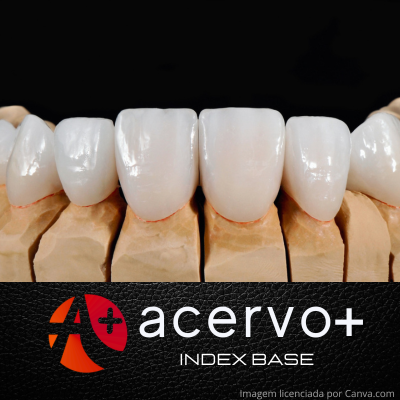
Keywords
Dental porcelain
Ceramics
Oral health
Periodontitis
How to Cite
Copyright © | All rights reserved.
The journal holds the exclusive copyright for the publication of this article under the terms of Brazilian law 9610/98.
Partial reproduction
The use of parts of the texts, figures and questionnaire of the article is free, being mandatory the citation of the authors and journal.
Total reproduction
It is expressly prohibited and must be authorized by the journal.
Abstract
Objective: To conduct an integrative literature review and to carry it out the guiding question: "What are the effects of dental veneers on the adjacent periodontium?". Methods: The Pubmed, Scielo, VHL and Google Scholar databases were used to search using the following keywords and/or in combination: dentalveneers, laminate venners, porcelain, ceramic, gingival health, periodontium effects and periodontitis. Studies published between 2013 and 2023, with the descriptors cited, in English, Portuguese, French, and Spanish, were included. Human studies, randomized and non-randomized clinical studies, prospective and retrospective clinical studies, and cohort studies were included. The exclusion criteria were: theses, monographs, book chapters, literature reviews and systematic reviews. Results: In the end, 12 articles were the object of this review. Final considerations: The use of ceramic dental veneers is a method with predictable clinical and aesthetic results, but it can occasionally cause inflammation, plaque buildup, bleeding, gingivitis, and gum recession. Maintaining periodontal health is possible with the monitoring and control of the dentist, who must have a thorough knowledge of the benefits and disadvantages of this treatment.
References
ALRAHLAH A, et al. Influence of Ceramic Lumineers on Inflammatory Periodontal Parameters and Gingival Crevicular FluidI L-6 and TNF-α Levels – A Clinical Trial. Applied Sciences,Basel, 2021; 11(6): 2829.
ARIFR, et al. Gingival Health of Porcelain Laminate Veneered Teeth: A Retrospective Assessment. Operative dentistry, Seattle, 2019; 44(5): 452-458.
ARISTIDIS GA e DIMITRA B. Five-Year Clinical Performance of Laminated Porcelain Veneers. Quint essenc enternational, Berlin, 2002; 33(3): 185-189.
ATTIA YS, et al. Survival of Hybrid Laminate Veneers using two diferente tooth preparation techniques: Randomized Clinical Trial. Brazilian dental Jornal, RibeirãoPreto, 2021; 32(6): 36-53.
BEIER US, et al. Clinical performance of porcelain laminate veneers for up to2 0years. The International jornal of prosth odontics, Lombard, 2012; 25(1): 79-85.
D’ARCANGELO C, et al. Protocol for a new concept of preparation - free ultra – thin ceramic veneers. The Journal of Esthetic and Restorative Dentistry, Inglaterra, 2018; 30: 173-9.
DE ANGELIS F, et al. Retrospective clinical evaluation of a no-prep porcelain veneer protocol. The Journal of prosthetic dentistry, St. Louis, 2023; 129(1): 40-48.
DEMIREKIN ZB e TURKASLAN S. Laminated ceramics in the aesthetic rehabilitation of tee thwith fluorosis: a10- yearfollow - upstudy. BMCOral Health, 2022; 22: 1-8.
EDELHOFF D, et al. Tooth structure remov al associated with various preparation designs for anterior teeth. TheJournal of prosthetic dentistry, St. Louis, 2002; 87: 503-9.
FEIL PH, et al. Intentional Use ofthe Hawthorne Effectto Improve Oral HygieneAdherence in OrthodonticPatients. Journalof dental education, Washington, 2002; 66(10): 1129-35.
ILDIRIM B, et al. Two-year evaluation of porcelain laminate veneers using FDI criteria. Journal of prosth odontics, Philadelphia, 2023; 32(9): 854-860.
JANG JH, et al. Laminatedporcelainveneersfittedwith a natural dental pontic: aprovisional approach for conservativeandaesthetictreatmentof a challenging case. Opera, Berna, 2015; 40: 257– 65.
KOYANAGI T, et al. Comprehensive microbiological findings in peri-implantitis and periodontitis. Journal of clinical periodontology, Copenhagem, 2013; 40(3): 218-226.
LIM TW, et al. SurvivalAndComplication Rates OfResinCompositeLaminateVeneers: A Systematic Review And Meta-Analysis. The jornal of evidence-based dental practice, St. Louis, 2023; 23(4): 101911.
MIHALI SG, et al. Retrospective Long-Term Clinical Out come of Felds pathic Ceramic Veneers. Materials, Basel, 2022; 15(6): 2150.
MOMBELLI A, et al. The epidemiology of peri-implantitis. Clinical or a limplants research, Copenhagem, 2012; 23: 67-76.
NEJATIDANESH F, et al. Five Years clinical out comes and survival of chair side CAD/CAM ceramic laminate veneers- aretrospective study. Journal of prosthodontic research, Tokyo, 2018; 62(4): 462-467.
OLIVEIRA D, et al. Clinical and Microbiologic Outcomes of Ceramic Laminate Veneers Bonded to Teeth Without a Finish Line: 1-year Results of a Prospective Study. The International jornal of prosth odontics, Philadelphia, 2023; 36(3): 244-252.
OZTÜRK Ee SÜKRAN BE. Survival of porcelain laminateve neers with diferente degrees of dentin exposure:2-year clinical results. Thej ournal of adhesive dentistry, Berlin, 2014; 16(5): 481-489.
PARK DJet al. Aesthetic improvement in the patient with a missin gupper central incisor restored with porcelain laminate veneers. The Journal of Advanced Prostho dontics, Korea, 2010; 2: 77-80.
PIPPINDJ, et al. Clinical evaluation of rest or edupper incisors: veneersvs. PMF crowns. TheJ ournal of the American Dental Association, Londres, 1995; 126(11): 1523–1539.
ROCHETTE AL. A ceramic restoration bonded by etche denamelan dresin for fractured incisors. The Journal of prosthetic dentistry, St. Louis, 1975; 33: 287- 293.
SANAN AM e MOUSA HD AM. Evaluation of Gingival Status of Two Finishing Lines of Veneer Restoration – Horizontal and Vertical Lines with Gingittage – A Comparative Clinical Study. Journal of Oraland Dental Research, Baghdah, 2022; 9(1): 32-38.
SILVA RN, et al. Integrative review as a method to generate ortotest nursing theory. Nursing Science Quarterly, Baltimore, 2020; 33(3): 258-263.
TEICHMANN M, et al. Periodontal out come and additional clinical quality criteria of lithium-disilicate rest orations (Empress2) after 14 years. Clinical oral investigations, Berlin, 2019; 23(5): 2153-2164.
TIWARI I, et al. Clinical and microbiological evaluation of marginal gingiva Around direct composite veneers. Journal of International Oral Health, Califórnia, 2016; 8(3): 367-373.
ZHANG R, et al. Analysis of the effects of prepared porcelain veneers and unprepared porcelain veneers on gingival crevicular flora basedon high-throughputsequencing.Experimentalandtherapeutic medicine,Atenas, 2021; 22(1): 777-783.