
Keywords
Tobacco Use Disorder
Oral Health
How to Cite
Copyright © | All rights reserved.
The journal holds the exclusive copyright for the publication of this article under the terms of Brazilian law 9610/98.
Partial reproduction
The use of parts of the texts, figures and questionnaire of the article is free, being mandatory the citation of the authors and journal.
Total reproduction
It is expressly prohibited and must be authorized by the journal.
Abstract
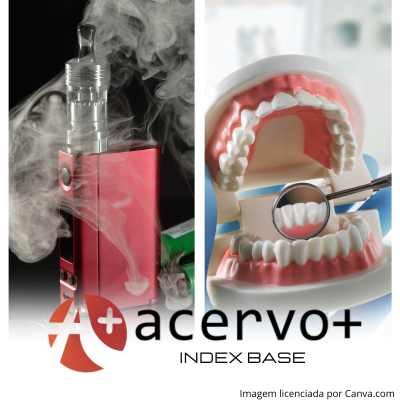
Objective: To analyze the knowledge of students at the Recife School of Dentistry about e-cigarettes and their effects on oral health. Methods: ninety-one students answered an online questionnaire about the use of these devices and their effects on oral health. Results: Most participants were female (85.7%) and were between 18 and 24 years old (83.5%). Most (97.8%) defended the interference of e-cigarettes in oral health. The most recognized oral alterations were hairy tongue (61.5%) and xerostomia (42.9%). Note that students in more advanced periods had more experience with patients who use vaping. There is also a lack of practical information about the real risks to oral health, including potentially malignant lesions and effects on the oral microbiota. Conclusion: The lack of knowledge about the functioning and components of these devices indicates the need for a more specific educational approach in undergraduate courses, integrating updated content with clinical and preventive disciplines.
References
ALQOBALY L, et al. Does smoking explain the association between use of e-cigarettes and self-reported periodontal disease? Journal of Dentistry, 2022; 122: 104164.
ANVISA atualiza regulação de cigarro eletrônico e mantém proibição. Disponível em: https://www.gov.br/anvisa/pt-br/assuntos/noticias-anvisa/2024/anvisa-atualiza-regulacao-de-cigarro-eletronico-e-mantem-proibicao. Acessado em: 21 de abril de 2024.
BRASIL. Ministério da Saúde. Agência Nacional de Vigilância Sanitária (ANVISA). Resolução da Diretoria Colegiada – RDC n° 46, de 28 de agosto de 2009. Diário Oficial da União, Brasília, DF, 28 ago. 2009.
CENTERS FOR DISEASE, CONTROL AND PREVENTION (CDC). Electronic cigarettes. Washington DC: CDC; 2019. Disponível em: https://www.cdc.gov/tobacco/basic_information/ecigarettes/. Acessado em: 17 de abril de 2022.
CORRÊA DE OLIVEIRA W, et al. Conhecimento e uso do cigarro eletrônico entre estudantes da Universidade Federal de Mato Grosso. J Bras Pneumol, 2018; 44(5): 367–369.
DAUTZENBERG B, et al. Practical guidelines on e-cigarettes for practitioners and others health professionals. Revue Des Maladies Respiratoires, 2017; 34(2): 155–164.
GELLER AC, et al. Tobacco cessation and prevention practices reported by second and fourth year students at US medical schools. Journalof General Internal Medicine, 2008; 23(7): 1071–1076.
GUCKERT EC, et al. Nível de conhecimento de estudantes do curso de graduação em Odontologia sobre cigarros eletrônicos. Revista da ABENO, 2021; 21(1): 1099.
HAMMOND D, et al. Use of JUUL E-cigarettes among youth in the United States. Nicotine & Tobacco Research, 2018; 22(5): 827–832.
JENSEN RP, et al. Hidden formaldehyde in E-cigarette aerosols. New England Journal of Medicine, 2015; 372(4): 392–394.
JONAS A. Impact of vaping on respiratory health. BMJ, 2022; 378: e065997.
KHEMISS M, et al. Oral health effects associated with narghile use. La Tunisie Medicale, 2016; 94(7): 401–411.
KIM SA, et al. Cariogenic potential of sweet flavors in electronic-cigarette liquids. PLOS ONE, 2018; 13(9): e0203717.
LIMA MENEZES I, et al. Cigarro eletrônico: mocinho ou vilão? Revista EstomatológicaHerediana, 2021; 31(1): 28–36.
MARTÍN CARRERAS-PRESAS C, et al. The need to educate future dental professionals on E-cigarette effects. European Journal of Dental Education, 2018; 22(4): e751–e758.
MCEWEN A, MCROBBIE H. Electronic cigarettes: a briefing for stop smoking services. Disponível em: https://www.ncsct.co.uk/publications/electronic_cigarette_briefing. Acessado em: 25 de janeiro de 2024.
MENEZES AMB, et al. Uso de cigarro eletrônico e narguilé no Brasil: um cenário novo e emergente. O estudo Covitel, 2022. Jornal Brasileiro de Pneumologia, 2023; 49: e20220290.
MOSER D, et al. Quantification and cytotoxicity of degradation products (chloropropanols) in sucralose containing e-liquids with propylene glycol and glycerol as base. Toxicology and Applied Pharmacology, 2021; 430: 115727.
MOYSIDOU A, et al. Knowledge and perceptions about nicotine, nicotine replacement therapies and electronic cigarettes among healthcare professionals in Greece. InternationalJournalof Environmental Research and Public Health, 2016; 13(5): 514.
INSTITUTO NACIONAL DE CÂNCER (INCA); GOMES DA SILVA J. Ministério da Saúde. Disponível em: https://www.inca.gov.br/sites/ufu.sti.inca.local/files/media/document/politica-nacional_de-controle-do-tabaco-2015.pdf. Acessado em: 24 de janeiro de 2024.
PERES MA, et al. Oral diseases: a global public health challenge. The Lancet, 2019; 394(10194): 249–260.
PRADO RADP, et al. Narguile: crenças em relação ao uso. Desafios da Gestão: Econômico, Social e Ambiental, 2012.
SANTOS BRM DOS, et al. Perfil e expectativas dos ingressantes da Faculdade de Odontologia da USP: uma visão integrada com as diretrizes curriculares nacionais e o sistema único de saúde. Revista da ABENO, 2015; 15(1): 28–37.
SULTAN AS, et al. Electronic nicotine delivery systems: oral health implications and oral cancer risk. Journalof Oral Pathology & Medicine, 2018; 50(3).
URRUTIA-PEREIRA M, et al. Prevalence and factors associated with smoking among adolescents. Jornal de Pediatria, 2017; 93(3): 230–237.
WALLEY SC, et al. A public health crisis: electronic cigarettes, vape, and JUUL. Pediatrics, 2019; 143(6): e20182741.
ZAID K, et al. p53 overexpression in oral mucosa in relation to shisha smoking in Syria and Lebanon. PubMed, 2018; 19(7): 1879–1882.