
Keywords
Ageusia
Low-level light therapy
How to Cite
Copyright © | All rights reserved.
The journal holds the exclusive copyright for the publication of this article under the terms of Brazilian law 9610/98.
Partial reproduction
The use of parts of the texts, figures and questionnaire of the article is free, being mandatory the citation of the authors and journal.
Total reproduction
It is expressly prohibited and must be authorized by the journal.
Abstract
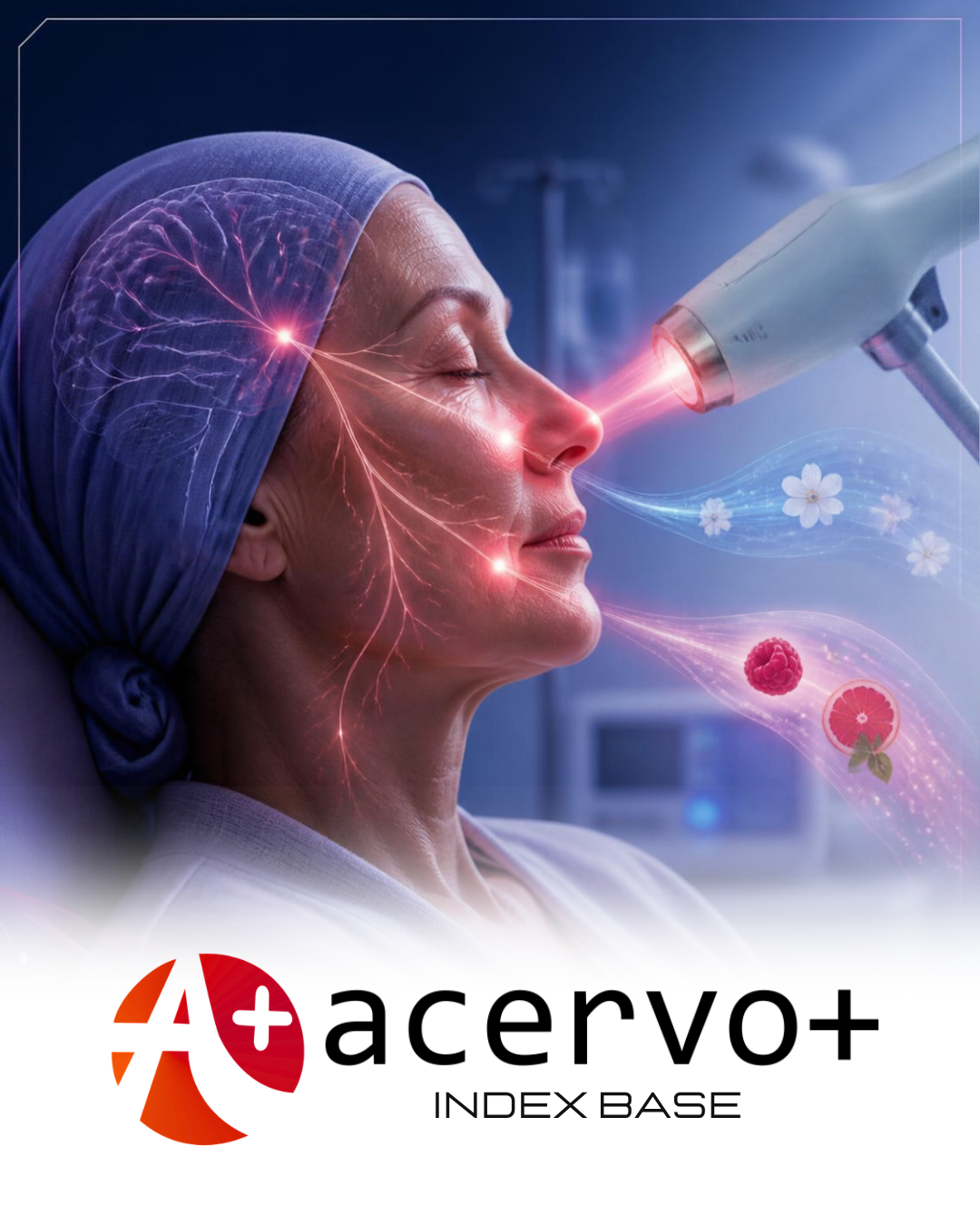
Objective: To report the management of self-reported complaints of ageusia and anosmia in an oncology patient undergoing chemotherapy, using laser photobiomodulation combined with home-based sensory stimulation. Case details: A 75-year-old male patient diagnosed with multiple myeloma with amyloid deposition and receiving chemotherapy was referred by the Oncology service due to progressive taste loss, subsequently reporting absence of smell. Fifteen photobiomodulation sessions were performed twice weekly using an 808 nm infrared laser, with 100 mW power and a 0.03 cm² beam/spot area. The approach was combined with home exercises involving gustatory and olfactory stimuli. Progress was monitored before each session using a 0-to-10 Numerical Rating Scale. During follow-up, partial self-reported improvement was observed, with identification of specific odors and tastes, symptom fluctuation, and differentiation between sweet and salty tastes at the end of the protocol. At a follow-up visit, the patient reported a 5 kg weight gain and gradual recovery of pleasure in eating. Final considerations: The combined approach showed clinical feasibility and no recorded adverse events; however, the outcomes cannot be attributed exclusively to photobiomodulation, and further studies are needed using standardized gustatory and olfactory tests.
References
BUTTIRON WT, et al. Taste and smell disorders in cancer treatment: results from an integrative rapid systematic review. International Journal of Molecular Sciences, 2023; 24(3): 2538.
CHENG K, et al. Mechanisms and pathways of pain photobiomodulation: a narrative review. The Journal of Pain, 2021; 22(7): 763-777.
DRARENI K, et al. Chemotherapy-induced taste and smell changes influence food perception in cancer patients. Supportive Care in Cancer, 2021; 29(4): 2125-2132.
EL MOBADDER M, NAMMOUR S. Photobiomodulation for taste alteration. Encyclopedia, 2021; 1(1): 240-248.
HAWKINS D, ABRAHAMSE H. Effect of multiple exposures of low-level laser therapy on the cellular responses of wounded human skin fibroblasts. Photomedicine and Laser Surgery, 2006; 24(6): 705-714.
HERNÁNDEZ-BULE ML, et al. Unlocking the power of light on the skin: a comprehensive review on photobiomodulation. International Journal of Molecular Sciences, 2024; 25(8): 4483.
HOSSEINI SF, et al. The brain functional connectivity alterations in traumatic patients with olfactory disorder after low-level laser therapy demonstrated by fMRI. Neuroradiol J. 2023;36(6):716-727.
MAGHFOUR J, et al. Photobiomodulation CME part I: overview and mechanism of action. Journal of the American Academy of Dermatology, 2024; 91(5): 793-802.
MALTA CEN, et al. Photobiomodulation therapy prevents dysgeusia chemotherapy induced in breast cancer women treated with doxorubicin plus cyclophosphamide: a triple-blinded, randomized, placebo-controlled clinical trial. Supportive Care in Cancer, 2022; 30(3): 2569-2580.
MAZZOLENI B, et al. Non-pharmacological strategies to alleviate dysgeusia in patients undergoing chemotherapy: a systematic review. European Journal of Oncology Nursing, 2024; 70: 102569.
OLIVEIRA PC, et al. Efficacy of the adjunctive use of photobiomodulation therapy in olfactory disorders in post-COVID-19 patients: a randomized controlled trial. Brazilian Journal of Otorhinolaryngology, 2025; 91(4): 101583.
ROBIJNS J, et al. Photobiomodulation therapy in management of cancer therapy-induced side effects: WALT position paper 2022. Frontiers in Oncology, 2022; 12:1-26.
RODRIGUES I, et al. Photobiomodulation therapy on chemo- and radiotherapy induced oral conditions: an umbrella review. BMC Oral Health, 2024; 24: 1106.
ROSATI D, et al. Taste and smell alterations (TSAs) in cancer patients. Diseases, 2024; 12(6): 130.
SALES DS, et al. Post-COVID-19 olfactory and gustatory dysfunction: photobiomodulation therapy as a treatment option in a series of cases. The Open Neurology Journal, 2023; 17: e1874205X2309190.
SALES PVA, et al. Mechanisms of photobiomodulation therapy in treating and preventing antineoplastic-induced oral mucositis: a systematic review. Acta Cirúrgica Brasileira, 2025; 40: e403125.
SEVRYUGIN O, et al. Taste and smell disturbances in cancer patients: a scoping review of available treatments. Supportive Care in Cancer, 2021; 29(1): 49-66.
SHABAAN AA, et al. Diode laser in management of loss of taste sensation in patients with post-COVID syndrome: a randomized clinical trial. BMC Oral Health, 2023; 23(1): 263.
SOARES LES, et al. Intranasal photobiomodulation therapy for COVID-19-related olfactory dysfunction: a Brazilian multicenter case series. Photodiagnosis and Photodynamic Therapy, 2021; 36: 102574.
TELLES-ARAUJO GT, et al. Photobiomodulation in the management of persistent olfactory and gustatory dysfunction post-COVID-19: a systematic review. Lasers in Medical Science, 2025; 40: 283.
YADAV N, et al. A subjective assessment of chemotherapy drug-induced taste and smell alteration in non-head and neck cancer patients: a questionnaire-based cross-sectional study. Cureus, 2024; 16(4): e57787.