
Palabras clave
Enfermedad de Crohn
Fístula
Cómo citar
Copyright © | Todos los derechos reservados.
La revista posee los derechos de autor exclusivos para la publicación de este artículo en los términos de la ley brasileña 9610/98.
Reproducción parcial
El uso de partes de los textos, figuras y cuestionario del artículo es libre, siendo obligatoria la citación de los autores y revista.
Reproducción total
Está expresamente prohibido y debe ser autorizado por la revista.
Resumen
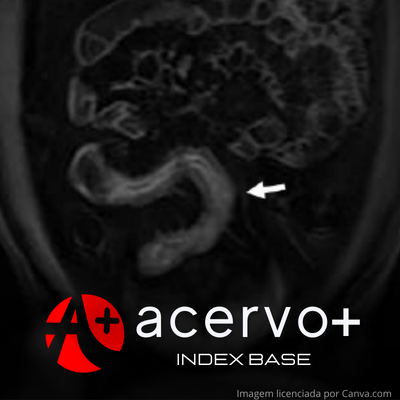
Objetivo: Presentar el caso de un paciente con un retraso diagnóstico de 15 años por Enfermedad de Crohn (EC) Fibroestenosante-Fistulante, diagnosticado en un estadio avanzado de fístula entero-sigmoidea, describiendo la evolución clínica y las intervenciones realizadas. Detalle del Caso: Paciente masculino, 27 años, fumador, con reporte de dolor abdominal crónico asociado a diarrea desde los 14 años. Pruebas de laboratorio que muestran niveles elevados de inflamación y anticuerpos anti-Saccharomyces cerevisiae (ASCA) positivos. Colonoscopia sugestiva de EC activa y enterorresonancia con regiones de estenosis en íleon distal y fístula íleo-sigmoidea con indicación de abordaje quirúrgico. El paciente presentaba EC refractaria al tratamiento con corticoides, requiriendo múltiples optimizaciones terapéuticas y cambio del inmunobiológico de Infliximab (IFX) a Adalimumab (ADA) por desarrollo de inmunorresistencia a IFX, con resolución de la cicatrización de la fístula a expensas de agrandar las áreas de estenosis, mantener los patrones de exacerbación y remisión de la enfermedad. Consideraciones finales: El retraso diagnóstico de 15 años por síntomas inespecíficos, curso clínico intermitente y pérdida de seguimiento del paciente, además del tabaquismo, fueron fundamentales para la progresión del proceso inflamatorio crónico y el desarrollo de un perfil más agresivo de la enfermedad.
Referencias
BECHARA CS, et al. Montreal classification of patient operated for Crohn’s disease and identification of surgical recurrence predictors. Revista Do Colégio Brasileiro de Cirurgiões, 2015; 42(2): 97–104.
BLACKWELL J, et al. Prevalence and Duration of Gastrointestinal Symptoms Before Diagnosis of Inflammatory Bowel Disease and Predictors of Timely Specialist Review: A Population-Based Study. Journal of Crohn's and Colitis, 2021; 15(2): 203–211.
BRAZILIAN STUDY GROUP OF INFLAMMATORY BOWEL DISEASE. Diretrizes de Doença de Crohn Int J Inflamm Bowel Dis., 2018; 4(1): 10–41.
BYE WA, et al. Strategies for Detecting Colorectal Cancer in Patients with Inflammatory Bowel Disease: A Cochrane Systematic Review and Meta-Analysis. Am J Gastroenterol., 2018; 113(12): 1801-1809.
COLOMBEL J-F, et al. Combination Therapy With Infliximab and Azathioprine Improves Infliximab Pharmacokinetic Features and Efficacy: A Post Hoc Analysis. Clinical Gastroenterology and Hepatology, 2019; 17: 1525–1532.
CONSIGNY Y, et al. A simple biological score for predicting low risk of short-term relapse in Crohn’s disease. Inflamm Bowel Dis., 2006; 12: 551–557.
D’INCÀ R, et al. Calprotectin and lactoferrin in the assessment of intestinal inflammation and organic disease. Int J Colorectal Dis., 2007; 22(4): 429-37.
GLASSNER KL, et al. The microbiome and inflammatory bowel disease. J Allergy Clin Immunol., 2020; 145(1): 16-27.
HANAUER SB, et al. Human anti-tumor necrosis factor monoclonal antibody (adalimumab) in Crohn’s disease: the CLASSIC-I trial. Gastroenterology, 2006; 130: 323-33.
HANAUER SB, et al. Maintenance infliximab for Crohn’s disease: the ACCENT I randomised trial. Lancet, 2002; 359: 1541-9 .
HENRIKSEN M, et al. C-reactive protein: a predictive factor and marker of inflammation in inflammatory bowel disease. Results from a prospective population-based study. Gut, 2008; 57: 1518–1523.
HONG Z, et al. Delayed Diagnosis is Associated with Early and Emergency Need for First Crohn's Disease-Related Intestinal Surgery. Med Sci Monit., 2017; 23: 4841-4846.
KISS LS, et al. High-sensitivity C-reactive Protein for identification of disease phenotype, active disease, and clinical relapses in Crohn’s Disease: A marker for patient classification? Inflamm Bowel Dis., 2012; 18: 1647–1654.
KOTZE LM, et al. Fecal Calprotectin: levels for the ethiological diagnosis in Brazilian patients with gastrointestinal symptoms. Arq Gastroenterol., 2015; 52(1): 50-4.
LEE DW, et al. Diagnostic delay in inflammatory bowel disease increases the risk of intestinal surgery. World J Gastroenterol., 2017; 23(35): 6474-6481.
MALHEIROS APR, et al. Tratamento da doença de Crohn com infliximabe: primeira opção? ABCD. Arquivos Brasileiros de Cirurgia Digestiva (São Paulo), 2009; 22(2): 101–104.
MARANHÃO DDA, et al. Características e diagnóstico diferencial das doenças inflamatórias intestinais. JBM, 2015; 103(1): 9-15.
MIKOCKA-WALUS AA, et al. Controversies surrounding the comorbidity of depression and anxiety in inflammatory bowel disease patients. Inflammatory Bowel Diseases, 2007; 13(2): 225–234.
N’GUYEN Y, et al. Fatal Epstein-Barr Virus Primo Infection in a 25-Year-Old Man Treated with Azathioprine for Crohn’s Disease. J Clin Microbiol., 2009; 47(4): 1252-4.
NAHON S, et al. Diagnostic delay in a French cohort of Crohn's disease patients. J Crohns Colitis, 2014; 8(9): 964-9.
NOBREGA VG, et al. The Onset of Clinical Manifestations in Inflammatory Bowel Disease Patients. Arq. Gastroenterol., 2018; 55(3): 290-295.
BOER NKH, et al. Thiopurines in Inflammatory Bowel Disease: New Findings and Perspectives. Journal of Crohn's and Colitis, 2018; 12(5): 610–20.
PERSOONS P, et al. The impact of major depressive disorder on the short- and long-term outcome of Crohn’s disease treatment with infliximab. Alimentary Pharmacology and Therapeutics, 2005; 22(2): 101–110.
PORITZ LS, et al. Remicade® Does Not Abolish the Need for Surgery in Fistulizing Crohn’s Disease. Dis Colon Rectum, 2002; 45(6): 771-5.
QUINTON FJ, et al. Anti-Saccharomyces cerevisiae mannan antibodies combined with antineutrophil cytoplasmic autoantibodies in inflammatory bowel disease: prevalence and diagnostic role. Gut, 1998; 42: 788-791.
SANDBORN WJ, et al. Adalimumab induction therapy for Crohn disease previously treated with infliximab: a randomized trial. Ann Intern Med., 2007; 146(12): 829–38.
SANDBORN WJ, et al. Evaluation of serologic disease markers in a population-based cohort of patients with ulcerative colitis and Crohn's disease. Inflamm Bowel Dis., 2001; 7(3): 192-201.
SANTOS LAA, et al. Terapia nutricional nas doenças inflamatórias intestinais: artigo de revisão. Nutrire 2015; 40(3): 383-396.
SINGH S, et al. Comparative efficacy and safety of biologic therapies for moderate-to-severe Crohn's disease: a systematic review and network meta-analysis. Lancet Gastroenterol Hepatol., 2021; 6(12): 1002-1014.
SIPAHI AM, et al. In: MARTINS MA, et al. Clínica Médica, Volume 4: Doenças do Aparelho Digestivo, Nutrição e Doenças Nutricionais. 2 ed. Editora Manole; 2016; 178-99 p.
SOLEM CA, et al. Correlation of C-reactive protein with clinical, endoscopic, histologic, and radiographic activity in inflammatory bowel disease. Inflamm Bowel Dis., 2005; 11(8): 707–12.
SPICELAND CM, LODHIA N. Endoscopy in inflammatory bowel disease: Role in diagnosis, management, and treatment. World J Gastroenterol., 2018; 24(35): 4014-4020.
VALERIO F, et al. Cancer in Crohn's disease: case report. Câncer em Doença de Crohn: Relato de Caso. Rev bras Coloproct,, 2006; 26(4): 443-6.
VAVRICKA SR, et al. Swiss IBD Cohort Study Group. Systematic evaluation of risk factors for diagnostic delay in inflammatory bowel disease. Inflamm Bowel Dis., 2012; 18(3): 496-505.
WOLTERS FL, et al. Systematic review: has disease outcome in Crohn's disease changed during the last four decades? Aliment Pharmacol Ther., 2004; 20(5): 483-96.
YAMAMOTO T. Factors affecting recurrence after surgery for Crohn’s disease. World Journal of Gastroenterology, 2005; 11(26): 3971.