
Palabras clave
Patología Bucal
Enfermedades de las Glándulas Salivales
Patología Quirúrgica
Cómo citar
Copyright © | Todos los derechos reservados.
La revista posee los derechos de autor exclusivos para la publicación de este artículo en los términos de la ley brasileña 9610/98.
Reproducción parcial
El uso de partes de los textos, figuras y cuestionario del artículo es libre, siendo obligatoria la citación de los autores y revista.
Reproducción total
Está expresamente prohibido y debe ser autorizado por la revista.
Resumen
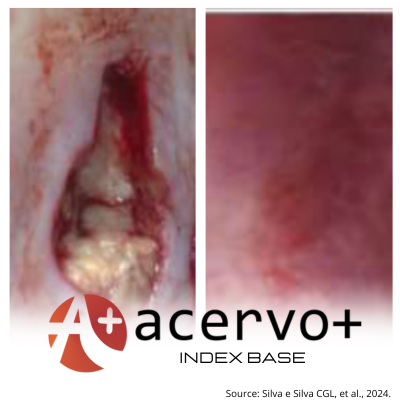
Objetivo: Informar el manejo clínico de una lesión ulcerada inflamatoria en el paladar de un paciente con trastorno gastrointestinal. Detalles del caso: Paciente de 48 años, acompañado de su esposa, acudió a la clínica dental de la Universidad Nilton Lins, reportando como queja principal la presencia de una herida en el paladar con ardor local que apareció en 1 mes, aumentando de tamaño rápidamente. La lesión aparece unilateralmente en la región posterior izquierda del paladar duro, con característica inflamatoria, consistencia fibrosa y color blanquecino, indicativa de isquemia local acompañada de síntomas de ardor y dolor a la palpación. Dadas las características presentadas en el caso, se decidió realizar biopsia incisional del tejido infectado y parte del tejido sano, con posterior evaluación histopatológica siguiendo la hipótesis de sialometaplasia necrotizante o carcinoma mucoepidermoide. Luego de la confirmación se realizó la remoción total del contenido patológico, demostrando éxito en el procedimiento elegido luego de 1 año de seguimiento. Consideraciones finales: La conducta fue satisfactoria. Sin embargo, se debe prestar atención a identificar los factores desencadenantes para resolver mejor el caso.
Referencias
ABDALLA-ASLAN R, et al. Necrotizing sialometaplasia of the palate in a young bodybuilder with anabolic androgenic steroids abuse. Quintessence Int., 2020; 51(6): 496-501.
COSTA E, et al. Necrotizing sialometaplasia on the hard palate after sequential induced vomiting: case study. Braz J Otorhinolaryngol., 2023; 90(2): 101385.
EL GAOUZI R, et al. A diagnostic error of a necrotizing sialometaplasia: case report. Ann Med Surg., 2022; 74: 103225.
FERNANDES PM, et al. Non-ulcerated necrotizing sialometaplasia may mimic a salivary gland tumor. Autops Case Rep., 2021; 11: e2021244.
GADKAREE SK, et al. Necrotizing Sialometaplasia of the Hypopharynx. Ear Nose Throat J., 2019; 98(9): NP138-NP141.
HAEN P, et al. Necrotizing sialometaplasia of the parotid gland associated with facial nerve paralysis. J Stomatol Oral Maxillofac Surg., 2017; 118(1): 63-5.
HASAN S, et al. Oral cavity and eating disorders: an insight to holistic health. J Family Med Prim Care, 2020; 9(8): 3890-97.
JOSHI SA, et al. Necrotizing sialometaplasia: a diagnostic dilema. J Oral Maxillofac Pathol., 2014; 18(3): 420-2.
LECHIEN JR, et al. Laryngopharyngeal reflux, gastroesophageal reflux and dental disorders: A systematic review. PLoS One, 2020; 15(8): e0237581.
LOPES VL, et al. Doenças de glândulas salivares: estudo epidemiológico em um serviço de estomatologia do sul do Brasil. RFO UPF, 2019; 24(2): 176-82.
MAHAJAN R, et al. Gastroesophageal reflux disease and oral health: a narrative review. Spec Care Dentist., 2022; 42(6): 555-64.
MEDEIROS MRS, et al. Necrotizing sialometaplasia: A report of two cases and review of the literature. Stomatologija, 2022; 24(2): 56-60.
NUTTALL E and WEHRMANN D. Bilateral asynchronous necrotizing sialometaplasia of the buccal mucosa: A case report and literature review. Cureus, 2022; 14(4): e24136.
PHILIPONE EM and PETERS SM. Ulcerative and inflammatory lesions of the oral mucosa. Oral Maxillofac Surg Clin North Am., 2023; 35(2): 219-26.
RIQUELME-M E and BADILLA-M R. Sialometaplasia necrotizante: revisión de la literatura a propósito de un caso. Int. J. Odontostomat., 2018; 12(2): 142-6.
ROCHA ESPÍRITO G, et al. Necrotizing Sialometaplasia in a Medically Compromised Patient-A Potential Diagnostic Pitfall. JAMA Otolaryngol Head Neck Surg., 2022; 148(8): 789-79.
RUSHINEK H, et al. Necrotizing sialometaplasia related to vomiting and silastic ring vertical gastroplasty. Quintessence Int., 2016; 47(2): 147-50.
SENTHILNATHAN N, et al. Necrotizing sialometaplasia: a diagnostic challenge to oral physicians. Cureus, 2022; 14(12): e33122.
THANDI BS, et al. Simultaneous presentation of dual pathologies within the oral cavity: an unusual and diagnostically challenging presentation. Br Dent J., 2023; 235(4): 250-4.
ZHURAKIVSKA K, et al. Necrotizing sialometaplasia can hide the presence of salivary gland tumors: A case series. Oral Dis., 2019; 25(4): 1084-90.