
Palabras clave
Ageusia
Terapia por luz de baja intensidad
Cómo citar
Copyright © | Todos los derechos reservados.
La revista posee los derechos de autor exclusivos para la publicación de este artículo en los términos de la ley brasileña 9610/98.
Reproducción parcial
El uso de partes de los textos, figuras y cuestionario del artículo es libre, siendo obligatoria la citación de los autores y revista.
Reproducción total
Está expresamente prohibido y debe ser autorizado por la revista.
Resumen
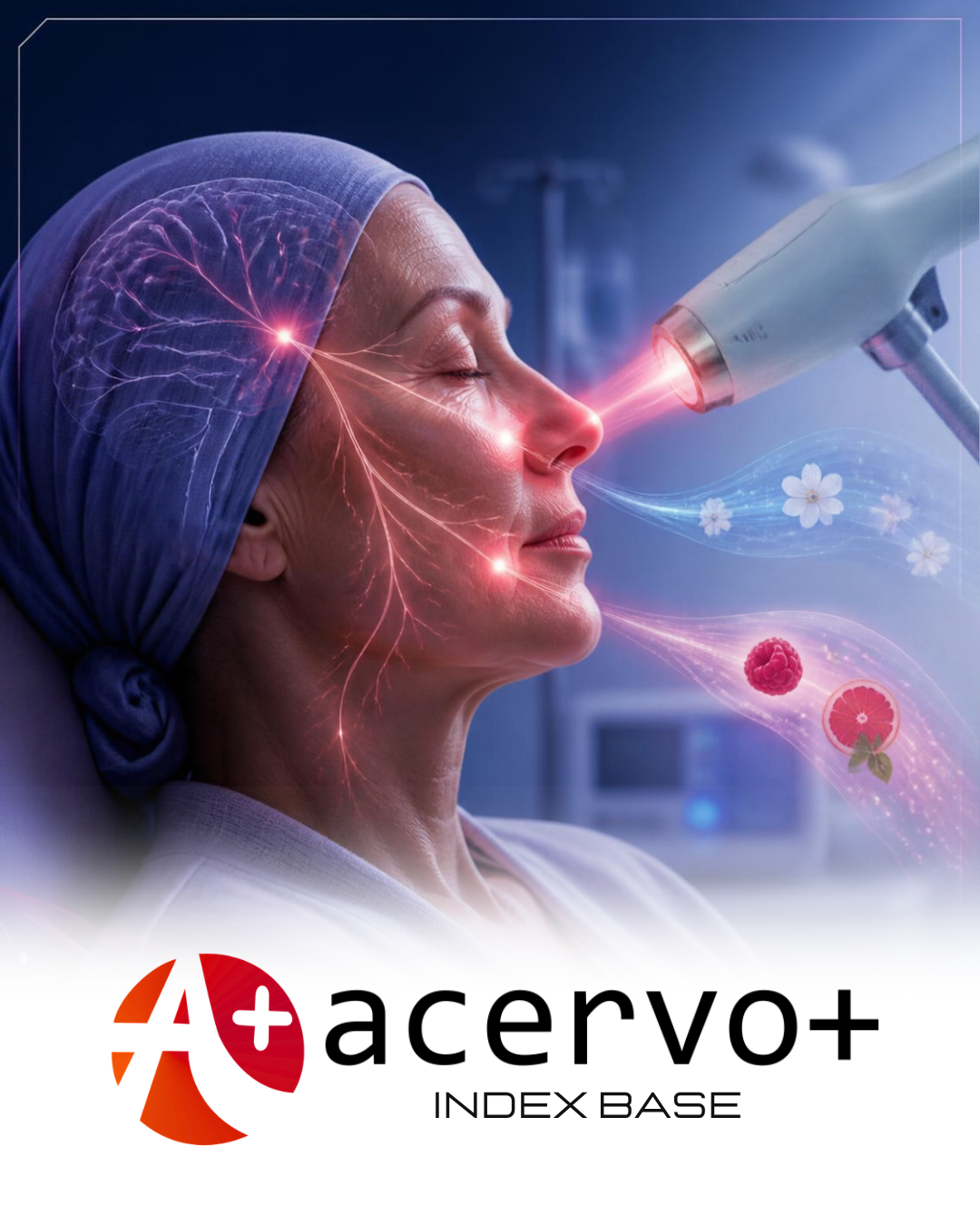
Objetivo: Relatar sobre el manejo de las quejas autoinformadas de ageusia y anosmia en un paciente con cáncer sometido a quimioterapia, utilizando fotobiomodulación láser combinada con estimulación sensorial en el hogar. Detalle del caso: Paciente masculino de 75 años, diagnosticado con mieloma múltiple con depósito amiloide y en tratamiento quimioterápico, fue derivado por el servicio de Oncología debido a la pérdida progresiva del gusto, relatando posteriormente ausencia del olfato. Se realizaron 15 sesiones de fotobiomodulación, dos veces por semana, utilizando láser infrarrojo de 808 nm, potencia de 100 mW y área del haz/spot de 0,03 cm². El abordaje se asoció a ejercicios domiciliarios con estímulos gustativos y olfativos. La evolución fue monitoreada antes de cada sesión mediante Escala Numérica de 0 a 10. Durante el seguimiento, se observó mejoría parcial autorreferida, con identificación de olores y sabores específicos, oscilación de los síntomas y diferenciación entre dulce y salado al final del protocolo. En la consulta de seguimiento, el paciente refirió aumento de peso de 5 kg y retorno gradual del placer alimentario. Consideraciones finales: El abordaje combinado mostró viabilidad clínica y ausencia de complicaciones registradas; sin embargo, los resultados no pueden atribuirse exclusivamente a la fotobiomodulación, siendo necesarios nuevos estudios mediante pruebas gustativas y olfatorias estandarizadas.
Referencias
BUTTIRON WT, et al. Taste and smell disorders in cancer treatment: results from an integrative rapid systematic review. International Journal of Molecular Sciences, 2023; 24(3): 2538.
CHENG K, et al. Mechanisms and pathways of pain photobiomodulation: a narrative review. The Journal of Pain, 2021; 22(7): 763-777.
DRARENI K, et al. Chemotherapy-induced taste and smell changes influence food perception in cancer patients. Supportive Care in Cancer, 2021; 29(4): 2125-2132.
EL MOBADDER M, NAMMOUR S. Photobiomodulation for taste alteration. Encyclopedia, 2021; 1(1): 240-248.
HAWKINS D, ABRAHAMSE H. Effect of multiple exposures of low-level laser therapy on the cellular responses of wounded human skin fibroblasts. Photomedicine and Laser Surgery, 2006; 24(6): 705-714.
HERNÁNDEZ-BULE ML, et al. Unlocking the power of light on the skin: a comprehensive review on photobiomodulation. International Journal of Molecular Sciences, 2024; 25(8): 4483.
HOSSEINI SF, et al. The brain functional connectivity alterations in traumatic patients with olfactory disorder after low-level laser therapy demonstrated by fMRI. Neuroradiol J. 2023;36(6):716-727.
MAGHFOUR J, et al. Photobiomodulation CME part I: overview and mechanism of action. Journal of the American Academy of Dermatology, 2024; 91(5): 793-802.
MALTA CEN, et al. Photobiomodulation therapy prevents dysgeusia chemotherapy induced in breast cancer women treated with doxorubicin plus cyclophosphamide: a triple-blinded, randomized, placebo-controlled clinical trial. Supportive Care in Cancer, 2022; 30(3): 2569-2580.
MAZZOLENI B, et al. Non-pharmacological strategies to alleviate dysgeusia in patients undergoing chemotherapy: a systematic review. European Journal of Oncology Nursing, 2024; 70: 102569.
OLIVEIRA PC, et al. Efficacy of the adjunctive use of photobiomodulation therapy in olfactory disorders in post-COVID-19 patients: a randomized controlled trial. Brazilian Journal of Otorhinolaryngology, 2025; 91(4): 101583.
ROBIJNS J, et al. Photobiomodulation therapy in management of cancer therapy-induced side effects: WALT position paper 2022. Frontiers in Oncology, 2022; 12:1-26.
RODRIGUES I, et al. Photobiomodulation therapy on chemo- and radiotherapy induced oral conditions: an umbrella review. BMC Oral Health, 2024; 24: 1106.
ROSATI D, et al. Taste and smell alterations (TSAs) in cancer patients. Diseases, 2024; 12(6): 130.
SALES DS, et al. Post-COVID-19 olfactory and gustatory dysfunction: photobiomodulation therapy as a treatment option in a series of cases. The Open Neurology Journal, 2023; 17: e1874205X2309190.
SALES PVA, et al. Mechanisms of photobiomodulation therapy in treating and preventing antineoplastic-induced oral mucositis: a systematic review. Acta Cirúrgica Brasileira, 2025; 40: e403125.
SEVRYUGIN O, et al. Taste and smell disturbances in cancer patients: a scoping review of available treatments. Supportive Care in Cancer, 2021; 29(1): 49-66.
SHABAAN AA, et al. Diode laser in management of loss of taste sensation in patients with post-COVID syndrome: a randomized clinical trial. BMC Oral Health, 2023; 23(1): 263.
SOARES LES, et al. Intranasal photobiomodulation therapy for COVID-19-related olfactory dysfunction: a Brazilian multicenter case series. Photodiagnosis and Photodynamic Therapy, 2021; 36: 102574.
TELLES-ARAUJO GT, et al. Photobiomodulation in the management of persistent olfactory and gustatory dysfunction post-COVID-19: a systematic review. Lasers in Medical Science, 2025; 40: 283.
YADAV N, et al. A subjective assessment of chemotherapy drug-induced taste and smell alteration in non-head and neck cancer patients: a questionnaire-based cross-sectional study. Cureus, 2024; 16(4): e57787.