
Keywords
Capoeira
Person with disabilities
How to Cite
Copyright © | All rights reserved.
The journal holds the exclusive copyright for the publication of this article under the terms of Brazilian law 9610/98.
Partial reproduction
The use of parts of the texts, figures and questionnaire of the article is free, being mandatory the citation of the authors and journal.
Total reproduction
It is expressly prohibited and must be authorized by the journal.
Abstract
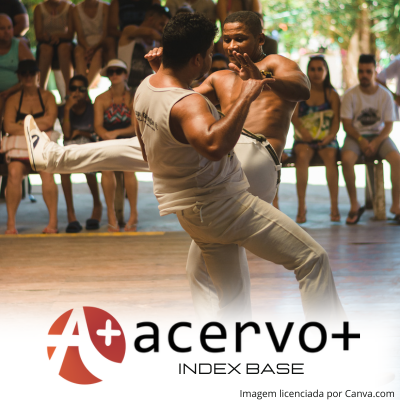
Objective: To report the influence of capoeira practice on people with Autism Spectrum Disorder (ASD) and other disabilities in social interaction, motor coordination, and autonomy. Experience report: This is an experience report, based on an extension project developed by the Instituto Federal Fluminense-Campus Cambuci that began in 2024. It prioritized the practice of capoeira as a pedagogical resource for the integral development of children and adolescents with disabilities enrolled in the Núcleo de Atendimento Educacional Especializado de Cambuci (NAEEC), located in the city of Cambuci/RJ. This article aims to present the importance of considering capoeira as a therapeutic and inclusive tool for the integral development of its practitioners. Final considerations: Based on the observations made, it was found that the teaching of capoeira, when associated with the appropriate adaptations to the potentialities and limitations of the students, contributes significantly to the integral development and promotion of the autonomy of people with ASD and intellectual disabilities. Furthermore, this experience highlighted the relevance of capoeira as a pedagogical and inclusive resource, promoting socialization and increasing the motivation of all participants in an educational context.
References
ASSUNÇÃO MR. Capoeira: the history of an Afro Brazilian martial art. London; New York: Routledge, 2005.
APA. AMERICAN PSYCHIATRIC ASSOCIATION. Manual diagnóstico e estatístico de transtornos mentais: DSM-5. Porto Alegre: Artmed, 2014; 5.
BOJANECK ML, et al. Alterações motoras em crianças com transtorno do espectro autista: uma revisão sistemática. Revista Brasileira de Educação Especial, 2020; 26(2): 259-276.
BRAZ MM e MARQUES AT. A capoeira como instrumento de inclusão social no ambiente escolar. Revista Brasileira de Educação Física e Esporte, 2018; 32(3): 511-518.
CARVALHO AR, et al. Capoeira: musicalidade para pessoas com deficiência intelectual. Revista da Sociedade Brasileira de Atividades Motora Adaptadas, 2020; 21(1): 69-77.
CORDEIRO WC. Capoeira: filosofia de vida e arte de transformação. Salvador: EDUFBA, 2003.
CORRÊA VP, et al. Impacto do exercício físico no transtorno do espectro autista: uma revisão sistemática. Revista Brasileira de Ciência e Movimento, 2020; 28(2): 89–99.
DIEHL ACS. Inclusão e práticas corporais: considerações sobre a atividade física adaptada. Revista da Sobama, 2006; 11(2): 5-13.
DIEHL ACS. Educação física adaptada: introdução ao conhecimento. Ijuí: Unijuí, 2006; 6.
FERNANDES DS, et al. Capoeira como prática corporal holística: uma abordagem interdisciplinar. Revista Brasileira de Ciências do Esporte, 2022; 44: 20220112.
FRANZONI WCC, et al. Children and the citys streets: playing as a possibility for leisure in different communities in Florianópolis, southern Brazil. Leisure Studies, 2022; 41: 1-14.
GREEN D, et al. Motor impairments in children with autism spectrum disorder: A systematic review and meta-analysis. Journal of Autism and Developmental Disorders, 2023; 53(4): 1234–1245.
GU Q, et al. Efeitos do exercício de habilidade aberta versus fechada na função cognitiva: uma revisão sistemática. Frontiers in Psychology, 2019; 10: 1707.
HEINE E, et al. A educação física adaptada no contexto da escola inclusiva: concepções e práticas pedagógicas. Revista Brasileira de Educação Física e Esporte, 2009; 23(4): 497–507.
LEWIS JE. Capoeira: the jogo de Angola from Luanda to cyberspace. Tese (Doutorado) — University of Illinois at Urbana-Champaign, 1994.
LOH A, et al. Motor functioning in children with autism spectrum disorders. Developmental Medicine & Child Neurology, 2007; 49(4): 297-302.
MARTÍNEZ M, et al. Improving motor skills and psychosocial behaviors in children with autism spectrum disorder: a pilot study of an adapted judo program. Frontiers in Psychology, 2022; 13.
MAGIL RA. Aprendizagem motora: conceitos e aplicações. São Paulo: Edgard Blücher, 1998; 5.
MATOS LR, et al. Capoeira e promoção da saúde: uma análise teórica. Revista Brasileira de Atividade Física & Saúde, 2010; 15(3): 195-200.
MELLO MT, et al. Capoeira: da tradição à inovação no campo da saúde e da educação. Revista Movimento, 2014; 20(3): 1095-1110.
MENEZES RP, et al. A capoeira como prática integradora no contexto educacional. Revista Brasileira de Ciências do Esporte, 2009; 31(1): 53-68.
MONTEIRO RCC, et al. Percepção de professores em relação ao processamento sensorial de estudantes com Transtorno do Espectro Autista. Revista Brasileira de Educação Especial, 2020; 26(4): 623–638.
MORALES J, et al. Improving motor skills and psychosocial behaviors in children with autism spectrum disorder through an adapted judo program. Frontiers in Psychology, 2022; 13.
MOREIRA RN, et al. Respostas fisiológicas e perceptivas agudas à prática da capoeira: uma revisão sistemática. Revista Brasileira de Ciência e Movimento, 2016; 24(2): 173–182.
NUNES CF. Capoeira e construção da cidadania: a prática como vetor de inclusão social. Revista Brasileira de Educação Física e Esporte, 2011; 25(2): 191-202.
OMS. ORGANIZAÇÃO MUNDIAL DA SAÚDE. Classificação Estatística Internacional de Doenças e Problemas Relacionados à Saúde – 11ª Revisão (CID-11). Genebra, 2022.
PAQUET A, et al. Muscle tone abnormalities in children with autism spectrum disorders: a systematic review. Research in Autism Spectrum Disorders, 2017; 34: 62-75.
PRATT HD e GREYDANUS DE. Intellectual disability (mental retardation) in children and adolescents. Primary Care: Clinics in Office Practice, 2007; 34(2): 375–386.
SAVALI C e DIAS L. Autismo e motricidade: contribuições da psicomotricidade. Revista Psicopedagogia, 2018; 35(106): 305-313.
SERRÃO CA. Capoeira: educação e movimento. Campinas: Autores Associados, 2005.
SILVA MP e COUTINHO T. A capoeira como ferramenta de inclusão para estudantes com autismo. Revista Educação e Emancipação, 2020; 13(1): 149-166.
SILVA RF. Capoeira como espaço de inclusão e melhoria da autoestima e interação de estudantes com TEA. Europub Journal of Multidisciplinary Research, 2022; 1(1): 14-30.
SILVA CRA capoeira como conteúdo da educação física escolar: uma proposta de ensino. Campinas: Autores Associados, 2011.
VAN DER PUTTEN AAJ, et al. Parents’ experiences of raising children with profound intellectual and multiple disabilities. Journal of Intellectual and Developmental Disability, 2014; 39(1): 45–55.
WATT N, et al. Repetitive behavior in children with autism: categorization and longitudinal change. Autism, 2008; 12(1): 27-45.