
Keywords
RPG
Waste Reuse
Maker Culture
Student Protagonism
How to Cite
Copyright © | All rights reserved.
The journal holds the exclusive copyright for the publication of this article under the terms of Brazilian law 9610/98.
Partial reproduction
The use of parts of the texts, figures and questionnaire of the article is free, being mandatory the citation of the authors and journal.
Total reproduction
It is expressly prohibited and must be authorized by the journal.
Abstract
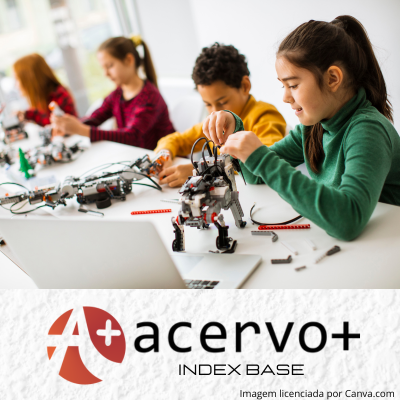
Objective: This article presents and analyzes the experience of an educational project developed with 6th and 7th grade elementary school students, integrating robotics, waste reuse, and Role-Playing Game (RPG) narrative as strategies to promote social sustainability, student protagonism, and scientific literacy. Experience report: Based on a sociointeractionist approach and active methodologies, the project was conducted through a gamified narrative in which the students, as characters in the “Quest for the Lost Technology,” faced challenges to recover and apply knowledge from an ancient fictional civilization. Using LEGO kits (Simple Machines 9656, WeDo 2.0, and EV3 Mindstorms), cardboard, recyclable materials, and low-cost electronic components, about 20 robots were built aimed at solving local problems, including the creation of educational toys and the promotion of sustainable mobility. Final considerations: The experience favored concrete learning, peer cooperation, and a closer relationship between school and community, reinforcing socio-environmental awareness. The results indicate that the combination of accessible technologies and immersive narratives expands student protagonism and enhances inclusive practices in elementary education.
References
AMARAL RB. RPG na escola: aventuras pedagógicas. Recife: Ed. Universitária da UFPE, 2013.
BRASIL. Base Nacional Comum Curricular. Brasília: MEC, 2018.
BRASIL. Referencial Curricular para Computação na Educação Básica. Brasília: MEC, 2023.
BRIGOLA HF. O RPG como metodologia ativa no ensino de geografia. Boletim de Conjuntura (BOCA), 2025; 23(67): 23–54.
DIAS DA SILVA MHP, et al. Letramento científico na mesa de RPG. Ensino & Pesquisa, 2025; 23(01): 225-235.
EIRAS AS, et al. Análise das ações da robótica educacional no âmbito da educação ambiental. Revista Vértices, 2023; 25(3): e25321140.
FREIRE P. Pedagogia da autonomia: saberes necessários à prática educativa. 23. ed. São Paulo: Paz e Terra, 1996.
GONÇALVES JÚNIOR M, et al. A importância da metodologia STEAM para a educação 4.0. Revista Acervo Educacional, 2023; 5: e2126.
LOPES DA SILVA C, et al. RPG e educação: a dupla face do jogo. Interfaces Científicas – Educação, 2023; 12(1): 359‑372.
MADUREIRA LS. Compreendendo o conceito de robótica pedagógica a partir de concepções ligadas à cibernética. Revista Acervo Educacional, 2023; 5: e12591.
NOGUEIRA C. Contribuições para a Educação Ambiental Crítica. Revista Brasileira de Educação Ambiental (RevBEA), 2023; 18(3): 156–171.
NOGUEIRA VG, et al. Robótica sustentável: uma alternativa ao desenvolvimento integrado à consciência ambiental com alunos do Ensino Fundamental I no município de Itacoatiara-AM. Revista Foco, 2023; 16(1): e628.
NUNES WB, et al. Educação ambiental na era digital: promovendo a sustentabilidade por meio da tecnologia e da inovação. Lumen et virtus, 2024; 15(43): 7761–7775.
SANTOS. Currículo Santista: Educação Integral. Prefeitura Municipal de Santos.
SANTOS SMC, BARREIROS PN. Entre memórias e histórias: tecendo experiências das narrativas orais ao RPG pelas vias da pedagogia dos multiletramentos. Sitientibus, 2022; 63: 23–30.
SAUL AM, SAUL A. Contribuições de Paulo Freire para a formação de educadores: fundamentos e práticas de um paradigma contra-hegemônico. Educar em Revista, 2016; 61: 19–35.
SILVA SMO, et al. Robótica educacional e competências do século XXI. Cuadernos de Educación y Desarrollo, 2025; 17(4): e8041.
SOUZA AJM. Considerações sobre o brincar: porque os brinquedos auxiliam e podem influenciar nos processos de aprendizado, Revista Acervo Educacional, 2020; 2: e2126.
VYGOTSKY LS. A formação social da mente. 7. ed. São Paulo: Martins Fontes, 2007.