
Palavras-chave
Privação do sono
SonoLesões musculoesqueléticas
Atletas
Como Citar
Copyright © | Todos os direitos reservados.
A revista detém os direitos autorais exclusivos de publicação deste artigo nos termos da lei 9610/98.
Reprodução parcial
É livre o uso de partes do texto, figuras e questionário do artigo, sendo obrigatória a citação dos autores e revista.
Reprodução total
É expressamente proibida, devendo ser autorizada pela revista.
Resumo
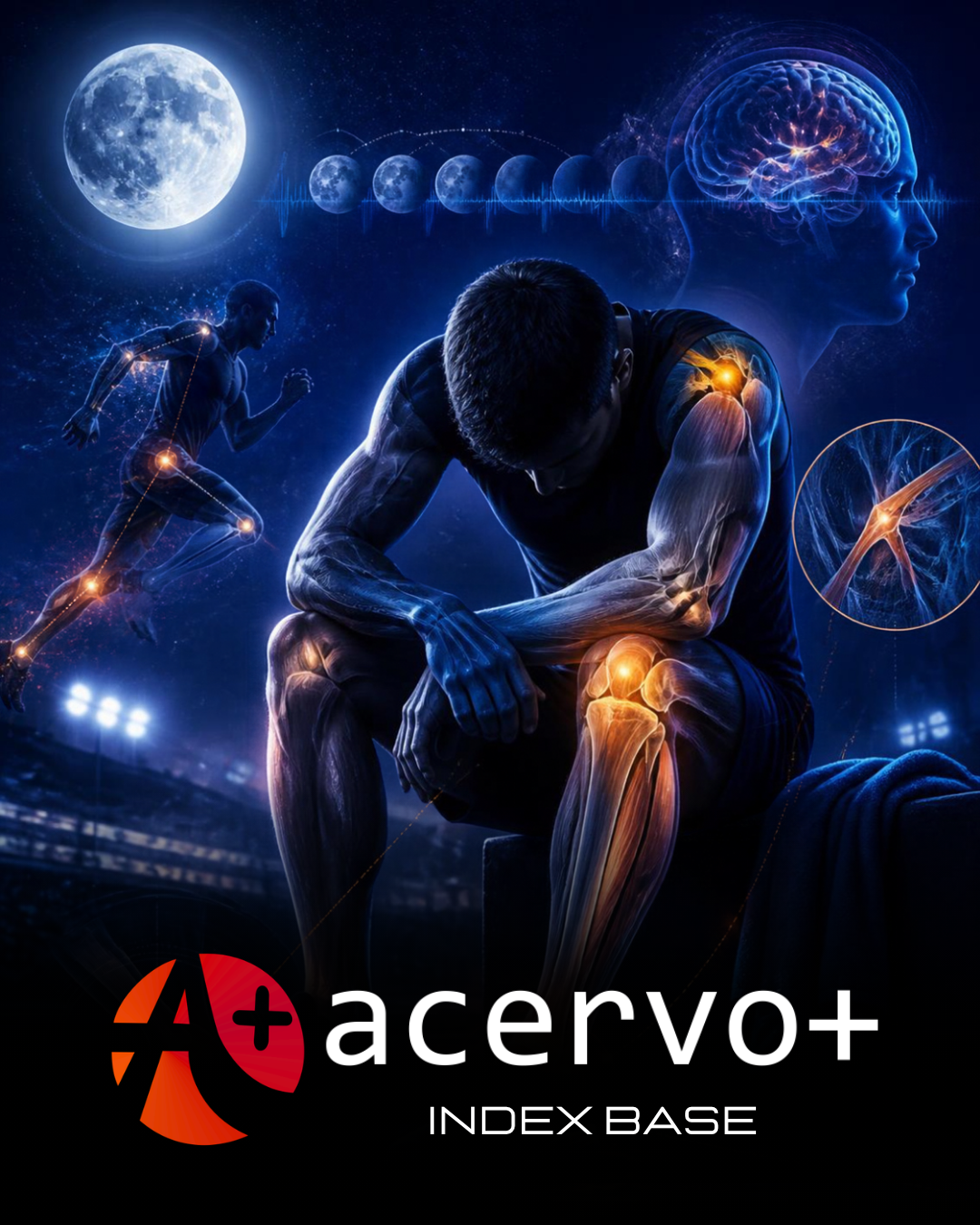
Objetivo: Analisar a associação entre privação do sono e risco de lesões musculoesqueléticas em atletas, considerando os mecanismos fisiológicos, hormonais, cognitivos e neuromusculares envolvidos. Revisão bibliográfica: O sono exerce papel essencial na recuperação metabólica, reparação tecidual e regulação hormonal. A privação do sono está associada à redução da secreção do hormônio do crescimento, aumento dos níveis de cortisol e comprometimento dos processos anabólicos responsáveis pela recuperação muscular. Além disso, alterações na arquitetura do sono prejudicam funções cognitivas e neuromusculares, como coordenação motora, tempo de reação e controle motor, elevando o risco de lesões esportivas. Em atletas, a associação entre elevada carga de treinamento e recuperação inadequada favorece fadiga neuromuscular crônica e maior ocorrência de lesões por sobrecarga. Considerações finais: O sono insuficiente está associado a um importante fator de risco para lesões musculoesqueléticas em atletas, tornando essencial a adoção de estratégias voltadas à melhora da qualidade e duração do sono.
Referências
ADAN A, et al. Circadian typology: a comprehensive review. Chronobiology International. 2012; 29(9):1153-1175.
CLEMENTE FM, et al. Relationships between sleep, athletic and match performance, training load, and injuries: a systematic review of soccer players. Healthcare. 2021; 9(7):808.
DATILLO M, ANTUNES HKM, MEDEIROS A, MÔNICO NETO M, SOUZA HS, TUFIK S, et al. Sleep and muscle recovery: endocrinological and molecular basis for a new and promising hypothesis. Medical Hypotheses. 2011; 77(2):220-222.
FINK AM, et al. Circadian rhythm and sleep disturbances in young adult athletes: a review about risk factors, consequences, and interventions. Brain Sciences. 2026; 16(2):212.
FULLAGAR HHK, SKORSKI S, DUFFIELD R, HAMMES D, COUTTS AJ, MEYER T. Sleep and athletic performance: the effects of sleep loss on exercise performance, and physiological and cognitive responses to exercise. Sports Medicine. 2015; 45(2):161-186.
GONG M, et al. Sleep deprivation and its effects on cognitive and physical performance in athletes: implications for injury risk. Sports Medicine. 2024; 54(1):45-58.
HAMLIN MJ. The effect of sleep quality and quantity on athlete’s health and perceived training quality. Frontiers in Sports and Active Living. 2021; 3:705650.
HAMLIN MJ, et al. Sleep, fatigue, and recovery in athletic performance: interactions with training load. International Journal of Sports Physiology and Performance. 2021; 16(4):567-574.
HARALDSDOTTIR K, et al. Decreased sleep and subjective well-being as independent predictors of injury in female collegiate volleyball players. Orthopaedic Journal of Sports Medicine. 2021; 9:23259671211029285.
HATIA M, et al. A narrative review of the impact of sleep on athletes: sleep restriction causes and consequences, monitoring, and interventions. Cureus. 2024; 16:e76635.
KILLGORE WDS. Effects of sleep deprivation on cognition. Progress in Brain Research. 2010; 185:105-129.
KIM TW, et al. The impact of sleep and circadian disturbance on hormones and metabolism. International Journal of Endocrinology. 2015; 2015:1-10.
LEPROULT R, et al. Role of sleep and sleep loss in hormonal release and metabolism. Endocrine Development. 2010; 17:11-21.
MASON L, et al. Sleep restriction impairs muscle recovery and anabolic signaling in athletes. European Journal of Sport Science. 2023; 23(5):789-798.
MASON L, et al. Sleep, nutrition, and injury risk in adolescent athletes: a narrative review. Nutrients. 2024; 15:5101.
MILEWSKI MD, et al. Chronic lack of sleep is associated with increased sports injuries in adolescent athletes. Journal of Pediatric Orthopaedics. 2014; 34(2):129-133.
RIEGLER KE, et al. Sleep as a predictor of injury risk in athletes: a systematic review. British Journal of Sports Medicine. 2023; 57(9):542-548.
ROENNEBERG T, ALLEBRANDT KV, MERROW M, VETTER C. Social jetlag and obesity. Current Biology. 2012; 22(10):939-943.
SIMPSON NS, et al. Optimizing sleep to maximize performance: implications and recommendations for elite athletes. Scandinavian Journal of Medicine & Science in Sports. 2017; 27(3):266-274.
VAN CAUTER E, LEPROULT R, KUPFER DJ. Effects of gender and age on the levels and circadian rhythmicity of plasma cortisol. Journal of Clinical Endocrinology & Metabolism. 2000; 81(7):2468-2473.
VIEGAS F, et al. The sleep as a predictor of musculoskeletal injuries in adolescent athletes. Nutrients. 2022; 14:4012.
VITALE JA, BONATO M, GALASSO L, LA TORRE A, MERATI G, MONTARULI A, et al. Sleep quality and high intensity interval training at two different times of day: a crossover study on the influence of the chronotype in male collegiate soccer players. Chronobiology International. 2019; 36(2):260-268.
VON ROSEN P, et al. Poor sleep quality is associated with injuries among adolescent athletes. Scandinavian Journal of Medicine & Science in Sports. 2017; 27(11):1365-1371.
WALKER MP. Why we sleep: unlocking the power of sleep and dreams. New York: Scribner; 2017.
WALSH NP, et al. Sleep and the athlete: narrative review and 2021 expert consensus recommendations. British Journal of Sports Medicine. 2021; 55(7):356-368.
WATSON AM. Sleep and athletic performance. Current Sports Medicine Reports. 2017; 16(6):413-418.
WATSON NF, et al. Recommended amount of sleep for a healthy adult: a joint consensus statement of the American Academy of Sleep Medicine and Sleep Research Society. Sleep. 2015; 38(6):843-844.