
Keywords
Dysplasia
Development
How to Cite
Copyright © | All rights reserved.
The journal holds the exclusive copyright for the publication of this article under the terms of Brazilian law 9610/98.
Partial reproduction
The use of parts of the texts, figures and questionnaire of the article is free, being mandatory the citation of the authors and journal.
Total reproduction
It is expressly prohibited and must be authorized by the journal.
Abstract
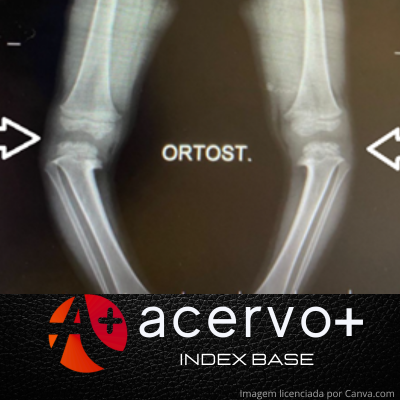
Objective: To report a rare case of opsismodysplasia (OPS), aiming to improve the understanding of this condition's manifestations and discuss the available clinical management options, given the generally poor prognosis that often accompanies the disease. Case Details: A case of a 5-year-old patient presenting with short stature, delayed bone growth, and skeletal abnormalities since birth. The main symptoms include limb shortening, macrocephaly, and deformities in the limbs and thorax. The diagnosis of OPS was confirmed through clinical evaluation and molecular testing, which identified variants in the INPPL1 gene. Since birth, the patient has been monitored by a multidisciplinary team. Corrective surgery for genu varum was performed at 4 years and 10 months of age. The definitive diagnosis was obtained in 2019 through exome sequencing, which revealed pathogenic variants. Despite supportive interventions, no curative treatment is currently available.Final Considerations: Opsismodysplasia poses both diagnostic and therapeutic challenges, requiring continuous follow-up to manage symptoms and improve quality of life. A multidisciplinary team is essential for the management of this complex and lifelong condition.
References
ABUMANSOUR IS, et al. Prenatal-onset INPPL1-related skeletal dysplasia in two unrelated families: Diagnosis and prediction of lethality. Clin Case Rep. 2021; 28(5): 9: 4079.
Al KAISSI A, et al. Atlanto-axial segmentation defects and os odontoideum in two male siblings with opsismodysplasia. Skeletal Radiol. 2009; 38(3): 293-6.
BARONCELLI GI, et al. Diagnosis, treatment, and management of rickets: a position statement from the Bone and Mineral Metabolism Group of the Italian Society of Pediatric Endocrinology and Diabetology. Front Endocrinol (Lausanne). 2024; 19(15): 1383681.
BEEMER FA, KOZLOWSKI KS. Additional case of opsismodysplasia supporting autosomal recessive inheritance. Am J Med Genet. 1994; 49(3): 344-7.
CORMIER-DAIRE V, et al. Clinical, radiological, and chondro-osseous findings in opsismodysplasia: survey of a series of 12 unreported cases. J Med Genet. 2003; 40(3): 195-200.
COUTO MT, et al. Gênero, saúde e cuidado: estudo sobre práticas de integralidade no contexto da Estratégia Saúde da Família em São Paulo, Brasil. Ciênc. Saúde Colet. 2019; 24(10): 3781-3792.
FRADET A, FITZGERALD J. INPPL1 gene mutations in opsismodysplasia. J Hum Genet. 2017; 62(2): 135-140.
GHOSH S, et al. Fibroblasts derived from patients with opsismodysplasia display SHIP2-specific cell migration and adhesion defects. Hum Mutat. 2017; 38(12): 1731-1739.
HUBER C, et al. Exome sequencing identifies INPPL1 mutations as a cause of opsismodysplasia. Am. J. Hum. Genet. 2013; (92): 144-149.
IRIART J, et al. DA busca pelo diagnóstico às incertezas do tratamento: desafios do cuidado para doenças genéticas raras no Brasil. Ciênc. Saúde Colet. 2019; 24(10): 3637-3650.
KHWAJA A, et al. Opsismodysplasia: Phosphate Wasting Osteodystrophy Responds to Bisphosphonate Therapy. Front Pediatr. 2015; 22(3): 48.
LI B, et al. Opsismodysplasia resulting from an insertion mutation in the SH2 domain which destabilizes INPPL1. Am J Med Genet A. 2014; 164(9): 2407-2411.
MAROTEAUX P, et al. Opsismodysplasia: a new type of chondrodysplasia with predominant involvement of the bones of the hand and the vertebrae. Am J Med Genet Part A. 1984; 19(1): 171-182.
PIRES P, TELLES J. Displasia esquelética. Tratado de Ultrassonografia V Medicina Fetal – Atualidades e Perspectivas. 2015; 289-299p.
RAMOS FJ, et al. A further case of opsismodysplasia with hydrocephalus. Eur J Med Genet. 2006; 49(1): 93-100.
CATSYNE CAV, et al. Altered chondrocyte differentiation, matrix mineralization and MEK-Erk1/2 signaling in an INPPL1 catalytic knock-out mouse model of opsismodysplasia. Adv Biol Regul. 2020; 76: 100651.