

WORD TEMPLATE
The article must be submitted using this template; otherwise, the submission will not be accepted. Avoid delays and rejections.
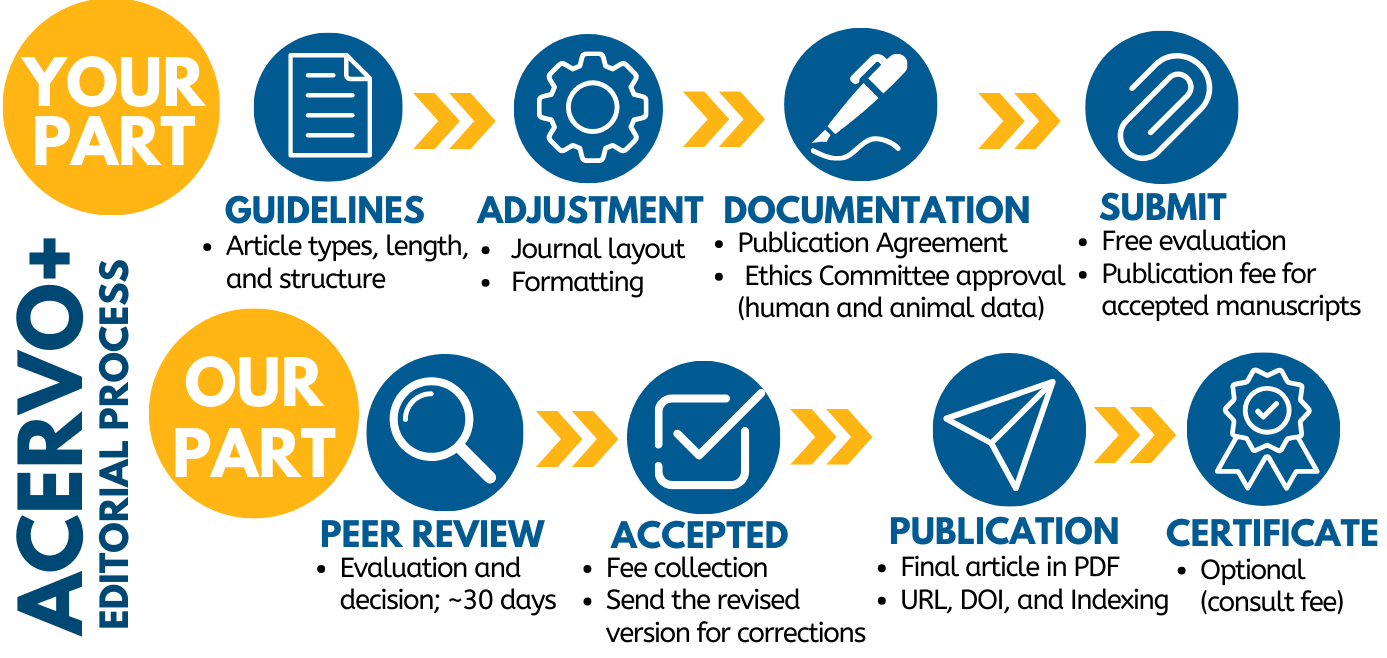
1. General guidelines +
I) The journal accepts articles written in Portuguese, English or Spanish that are original (not yet published) and that are NOT under review by any other journal.
II) We DO NOT accept preprints or any other form of pre-publication of content.
III) See below the types of articles accepted by A+ journals:

1.1. Original Article
I) Definition: Includes works that present original and unpublished data on findings related to experimental, quasi-experimental or observational aspects, aimed at qualitative and/or quantitative investigations in areas of interest to science. Theoretical grounding is required using quality scientific journal databases such as: Acervo+ Index base, Scielo, PubMed, MEDLINE, among others.
II) Structure: Introduction, Methods, Results, Discussion, Conclusion and References. *Results and Discussion may be presented together.
III) Length: Minimum 3,000 and maximum 3,500 words (excluding titles, abstracts, keywords, figures, tables, charts, captions and reference list).
IV) Ethics: (a) Research involving human beings or animals is subject to authorization by a Research Ethics Committee (CEP) under the terms of the law (RESOLUTION Nº 466/2012, Nº 510/2016 and LAW Nº 11.794). Analysis of DATASUS data does not require CEP approval. (b) Copying of texts and use of third-party images are not allowed, in compliance with current Copyright Laws (LAW Nº 9.610/1988 and Nº 10.695/2003). All references must be correctly cited.
V) Example:
1.2. Narrative Review
I) Definition: Has a descriptive-narrative purpose dedicated to presenting and summarizing topics of scientific interest. It uses scientific writing grounded in current original research data, through logical argumentation, theoretical-methodological critique and conclusive synthesis. It does not have a methodology section, since there are no defined criteria for the search of scientific articles; however, it is necessary to use quality scientific journal databases such as: Acervo+ Index base, Scielo, PubMed, MEDLINE, among others.
II) Structure: Introduction, Literature Review, Final Considerations and References.
III) Length: Minimum 3,000 and maximum 3,500 words (excluding titles, abstracts, keywords, figures, tables, charts, captions and reference list).
IV) Ethics: Copying of texts and use of third-party images are not allowed, in compliance with current Copyright Laws (LAW Nº 9.610/1988 and Nº 10.695/2003). All references must be correctly cited.
V) Example:
1.3. Integrative Review
I) Definition: Has an analytical-observational purpose dedicated to the relevance and impact of topics of scientific interest. It must aim to answer a specific and relevant question. It describes the process and criteria used to search and select the original studies included in the review and the procedures used to assess and categorize the articles. For the research to be comprehensive, it is necessary to use a search methodology with quality scientific journal databases such as: Acervo+ Index base, Scielo, PubMed, MEDLINE, among others.
II) Structure: Introduction, Methods, Results, Discussion, Final Considerations and References. *Results and Discussion may be presented together.
III) Length: Minimum 3,000 and maximum 3,500 words (excluding titles, abstracts, keywords, figures, tables, charts, captions and reference list).
IV) Ethics: Copying of texts and use of third-party images are not allowed, in compliance with current Copyright Laws (LAW Nº 9.610/1988 and Nº 10.695/2003). All references must be correctly cited.
V) Example:
1.4. Systematic Review
I) Definition: Has the purpose of synthesizing results of original studies, analyzing and characterizing a common variable that may result in a meta-analysis. It must aim to answer a specific and relevant question. It describes the process and criteria used to select the studies included in the review and the procedures used to synthesize the compiled data. For the research to be comprehensive, it is necessary to use a search methodology with quality scientific journal databases such as: Acervo+ Index base, Scielo, PubMed, MEDLINE, among others.
II) Structure: Introduction, Methods, Results, Discussion, Final Considerations and References. *Results and Discussion may be presented together.
III) Length: Minimum 3,000 and maximum 3,500 words (excluding titles, abstracts, keywords, figures, tables, charts, captions and reference list).
IV) Registration: Registration in the international PROSPERO database is mandatory (ACCESS DATABASE), and the approval number must appear in the methods section of the article.
V) Ethics: Copying of texts and use of third-party images are not allowed, in compliance with current Copyright Laws (LAW Nº 9.610/1988 and Nº 10.695/2003). All references must be correctly cited.
VI) Example:
1.5. Case Study
I) Definition: Includes works that address relevant and innovative clinical/theoretical/technical/scientific issues with an observational narrative based on case evolution. The case description should be succinct, avoiding redundant or irrelevant data. Theoretical grounding is required using quality scientific journal databases such as: Acervo+ Index base, Scielo, PubMed, MEDLINE, among others.
II) Structure: Introduction, Case Description, Discussion and References.
III) Length: Minimum 2,500 and maximum 3,000 words (excluding titles, abstracts, keywords, figures, tables, charts, captions and reference list).
IV) Ethics: (a) Research involving human beings is subject to authorization by a Research Ethics Committee (CEP) under the terms of the law (RESOLUTION Nº 466/2012). (b) Copying of texts and use of third-party images are not allowed, in compliance with current Copyright Laws (LAW Nº 9.610/1988 and Nº 10.695/2003). All references must be correctly cited.
NOTE ON ETHICAL PROCEDURE:
The National Commission for Research Ethics (CONEP), in Circular Letter nº 166, item 2, subitem “a”, clarifies regarding case studies/reports: "[...] The proposal must be submitted via Plataforma Brasil and assessed by the CEP/Conep system before its publication or dissemination” (OFFICIAL SOURCE). The commission justifies that this modality may cause moral and material damage regarding confidentiality of information.
Given the ethical and moral responsibility of Acervo+ Index base and its journals in ensuring compliance with research guidelines, approval by the CEP will be required in all case study submissions. If the authors do not have this document, the submission will be rejected and the authors will be advised about the need to request it from the competent body.
The CEP evaluation procedure tends to be simple, since this type of study does not have a full research project and the author may send the case report together with the Informed Consent Form (ICF) for approval.
V) Example:
1.6. Experience Report
I) Definition: Includes works that address relevant and innovative practical/technical/theoretical/scientific issues with an observational narrative based on practical experience. The report must be succinct, avoiding redundant or irrelevant data. Theoretical grounding is required using quality scientific journal databases such as: Acervo+ Index base, Scielo, PubMed, MEDLINE, among others.
II) Structure: Introduction, Experience Report, Discussion and References.
III) Length: Minimum 2,500 and maximum 3,000 words (excluding titles, abstracts, keywords, figures, tables, charts, captions and reference list).
IV) Ethics: (a) For this type of article, patient data, images showing groups of people, or photos of institutions are not accepted. Content, tools or forms created by the authors and used during practical experience may be presented. (b) Copying of texts and use of third-party images are not allowed, in compliance with current Copyright Laws (LAW Nº 9.610/1988 and Nº 10.695/2003). All references must be correctly cited.
V) Example:
2. Specific guidelines +
2.1. Title
I) Definitions: Must be concise, informative and textually accurate.
II) Language: Must be presented in three languages: Portuguese, English and Spanish.
III) Length: A maximum of 150 characters WITHOUT spaces.
2.2. Names and affiliation
I) Guidance: Include the full names of the author and co-authors in:
- a. the article file;
- b. the authorship statement sent to the journal;
- c. the journal's submission system.
II) Number of people: Maximum of 10 people, including the advisor/supervisor or principal investigator.
a. Reason: The aim is to value the creative and constructive process of the authors, and the limit of 10 people is sufficient considering the word count allowed for a scientific article.
b. Note: It is forbidden to remove or omit authors solely to meet the maximum number of authors accepted by the journal. It is important to emphasize that the journal repudiates unethical practices and is not responsible for any bad faith on the part of authors.
III) Authorship/co-authorship rights: Recognition of participation in the article must meet the following conditions:
- a. Conception and design, or analysis and interpretation of data;
- b. Drafting the article or critical review of important intellectual content;
- c. Final approval of the version to be published.
Note: The three conditions above must all be met, and, in line with this guideline, the Copyright Law Nº 9.610/1998, Article 15, § 1, states that: [...] "Anyone who merely assisted the author in producing the literary, artistic or scientific work by revising it, updating it, or supervising or directing its edition or presentation by any means shall not be deemed a co-author."
IV) Order of authors: The authors will decide by consensus the authorship order and sequence of names, preferably using contribution as the criterion. We recommend avoiding lottery or alphabetical order methods.
V) Advisor / Principal Investigator: This is the author or co-author who is legally responsible for the article. Their role is to validate the content of the work, ensuring scientific quality and compliance with research legislation and ethics. Therefore, technical-scientific and professional competencies are required to guide and ensure the success of the study. For this reason, the Advisor / Principal Investigator must be a professor or researcher with training in the field of the study or a related area, and must have notable knowledge about the topic. The journal’s committee will assess the Lattes CV to verify compliance with these requirements.
- The following may act as advisors/responsible for articles:
- a. Professors with institutional affiliation;
- b. Master’s, PhD or Postdoctoral students;
- c. Practicing professionals in the clinical area with professional registration;
- d. Independent researchers who can prove research activity.
VI) Corresponding author: The author/co-author who started the article submission process in the system. The corresponding author is responsible for responding to the journal’s notifications within the established deadline, providing information or documents relevant to the evaluation and publication process. Submissions sent by third parties will NOT be accepted.
2.3. Abstract
I) Definition: Its purpose is to present the reader with a general idea of the article: objectives, main findings, considerations and possible conclusions. It must be written clearly, objectively and attractively, so that the reader is encouraged to read the full article.
II) Language: Must be presented in three languages: Portuguese (Resumo), English (Abstract) and Spanish (Resumen).
III) Length: Between 150 and 200 words.
IV) Abstract structure: Click on each type of study below to see an example.
2.4. Keywords
I) Guidance: Must be defined based on the topic, field and/or subjects addressed in the article.
II) Number: Minimum of 3 and maximum of 5 (in Portuguese, English and Spanish).
III) Mandatory for health articles and related areas: All keywords must be registered in the Health Sciences Descriptors system (DeCS). You can use the DeCS system to search or to define terms for your article. Click on the image below:

2.5. Introduction
I) Guidance: Must be succinct and understandable to the general reader, defining the problem studied, summarizing its importance and highlighting the knowledge gaps that will be addressed in the article.
II) Acronyms and abbreviations: When used for the first time, the full meaning must be written out. Example: Universidade Federal de Pernambuco (UFPE).
III) Objective: The last paragraph of the introduction must present the objective of the study. It must state the main proposal of the study and begin with a verb in the infinitive: to analyze, to investigate, to assess, etc.
IV) Use of citations in the text:
a. All paragraphs must include indirect citation using theoretical grounding with current sources (preferably from the last 5 years) from quality scientific journal databases such as: Acervo+ Index base, Scielo, PubMed, MEDLINE, among others.
b. Direct quotations (copy) are allowed ONLY when it is not possible to paraphrase the idea, as in the case of legal texts; these must be highlighted in the text with a 3 cm indentation, quotation marks "" and italics.
c. We do not accept articles with footnotes. The theoretical discussion must be conducted throughout the text.
d. Citations of authors IN THE TEXT must follow these examples:
- Beginning of sentence:
- 1 author - Baptista JR (2022);
- 2 authors - Souza RE and Barcelos BR (2021);
- 3 or more authors - Porto RB, et al. (2020).
- End of sentence:
- 1 author - (BAPTISTA JR, 2022);
- 2 authors - (SOUZA RE and BARCELOS BR, 2021);
- 3 or more authors - (PORTO RB, et al., 2020);
- Sequence of citations - (BAPTISTA JR, 2022; SOUZA RE and BARCELOS BR, 2021; PORTO RB, et al., 2020).
2.6. Methods
I) Guidance: Must clearly and concisely describe the data sources, study population, sampling, selection criteria, analytical procedures and ethical issues related to study approval by a research ethics committee (research involving humans and animals) or institutional authorization (data collection in which there is no direct research with humans or animals).
II) Research instrument: Studies using questionnaires or forms already published must cite the source in the text and include it in the reference list. If the research instrument was created by the authors themselves, it must be cited in the text and submitted as a “separate file” for the journal’s committee to evaluate. If accepted, the instrument will be published as a supplementary file to the article.
III) Research ethics:
a. For studies in which CEP approval is legally mandatory, the authors must present in the last paragraph of the methods section the ethical procedures and the number of the opinion and the Certificate of Presentation for Ethical Consideration (CAAE).
b. For ORIGINAL studies in which there is a LEGAL exemption from CEP evaluation, the authors must justify this in the text and present the legal provision.
c. The journal is responsible for ensuring compliance with research ethics legislation for the content it publishes; therefore, all information will be checked.
2.7. Results
I) Guidance:
a. Must focus on describing the results found, including interpretations and comparisons clearly and following a logical sequence of presentation.
b. If the article contains figures with results, they must be cited in the text.
c. If the authors find it appropriate, they may present the Results and Discussion in a single section.
2.8. Figures
I) Definition: Images, tables, charts, graphs and illustrative drawings are all referred to as figures.
II) Number: A maximum of 6 figures is accepted.
III) Formatting: They must have a clear title at the top and the source at the bottom. If necessary to explain details or acronyms, include a caption. They must appear in the body of the article close to the relevant text.
IV) Guidance: Figures are original content protected by law. Therefore, the journal has established that:
a. Previously published figures will NOT be accepted: Regardless of license type, images that have already been published will NOT be accepted. The journal’s purpose is not to republish content, but to present the creative and authorial side of scientific work. This decision is based on the journal’s statutes.
c. Figures based on other publications: They may be created provided that the sources of inspiration are cited in the caption and that there are at least three (3) sources. The aim is to publish original images whose content is built through the authors’ reinterpretation, by means of analytical reflection. Cropped images from other publications are not original creations and will therefore NOT be accepted.
d. Figures created using software: It is mandatory to submit the authorization (license) for publication of the image issued by the software company. If the software has a free license, the author must send the license terms in PDF format, extracted from the company’s website (use the tool: print => save as PDF). The software name ®, license link and access date must be cited in the image caption. These requirements are based on the Industrial Property Law (LAW Nº 9.279/1996).
e. Image created by a professional: It is mandatory to submit the publication authorization (license) signed by the artist. The artist’s name must be cited in the image caption. These requirements are based on the Copyright Law (LAW Nº 9.610/1998).
f. Patient images in Case Studies: If test results and/or images of anatomical specimens from patients are used, authors must provide the Informed Consent Form (ICF) stating the use and publication of data and images. This form must be signed by the patient. These requirements are based on the Patient Medical Records Law (LAW Nº 13.787/2018). Remember that publication of Case Studies is subject to authorization by a Research Ethics Committee (CEP) under the terms of the law (RESOLUTION Nº 466/2012).
2.9. Discussion
I) Guidance: Must include the authors’ interpretation of the results and their main implications, comparison of findings with the literature, study limitations and possible directions for future research.
II) Argumentation: Articles that support and/or oppose the study’s findings must be presented, building a comparative discussion of the results.
III) Article sources: Sources MUST be current scientific articles (preferably from the last 5 years) from quality scientific journal databases such as: Acervo+ Index base, Scielo, PubMed, MEDLINE, among others.
Note: If the authors find it appropriate, they may present the Results and Discussion in a single section.
2.10. Conclusion and Final Considerations
I) Guidance: Must be consistent with the data presented and fully or partially answer the main research question stated as the objective. It must be limited to a single final paragraph, and the writing must explain the scientific outcome with the main findings and their impacts, research limitations and possible directions for future studies in the area.
Note: The text must be written clearly and concisely and may not contain citations.
2.11. Acknowledgements and Funding
I) Acknowledgements: Optional mention of people or institutions (entities, agencies or groups) that contributed to the study but did not meet the requirements to be co-authors (people) or funders (institutions). This is a space for professional acknowledgements; therefore, family or religious acknowledgements will NOT be allowed.
II) Funding: Mandatory mention of institutions or agencies that contributed financially to the development of the research. The full name of the institution/agency must be provided, followed by the grant number.
2.12. References
I) Number: Minimum of 20 and maximum of 40 scientific references.
II) Grounding: Use only scientific articles from the last 5 years whenever possible. Older references may be subject to rejection if reviewers do not consider them fundamental to the field of study.
a. Reason: The aim is to keep your article up to date and convey confidence both to those who read it and to those who use it as a reference.
b. Exception: The importance of an author’s concept and the relevance of the topic may justify the exceptional use of older sources. For example: it would not be possible to discuss psychoanalysis without citing Freud, whose publications date from 1895 to 1905; in such cases, the concept and topic require these citations.
III) Guidance:
a. Search for articles in scientific journal databases such as: Acervo+ Index base, Scielo, PubMed, MEDLINE, among other databases that maintain quality control of publications.
b. The journal will validate all sources and, if they are not compatible or relevant, their removal will be suggested.
c. In exceptional cases, literary works or official websites of technical-scientific bodies may be used, provided their importance to the field of study is demonstrated.
d. Sources from blogs, magazines, news sites, social networks or communication channels that are not scientific will not be accepted.
IV) Formatting: References must be numbered in alphabetical order according to the following examples:
- Article:
- 1 author - ANDREAZZI DUARTE D. Coronavirus, the microscopic monster from a scientific perspective. Revista Eletrônica Acervo Saúde, 2020; Esp. 46: e3606.
- 2 authors - QUEIROZ BG and MENDONÇA MA. The influence of recreational activities with oncology patients: a narrative review. Revista Eletrônica Acervo Médico, 2022; 12: e10461.
- 3 or more authors - TRAÚZOLA TR, et al. General overview of leprosy in Brazil: an epidemiological analysis. Revista Eletrônica Acervo Saúde, 2022; 15(6): e10223.
- Note: It is not necessary to provide “Available at” or the access date “Accessed on”.
- Book:
- Note: use books only in exceptional cases.
- SOBOTTA J. Atlas of Human Anatomy. 24th ed. Rio de Janeiro: Guanabara Koogan, 2018; 345 p.
- Thesis and Dissertation
- DEL ROIO LC. Socioeconomic impact on individuals with work-related asthma. Doctoral Thesis (PhD in Pulmonology) – School of Medicine of the University of São Paulo, São Paulo, 2022; 48 p.
- Web page:
- Note: use web pages only in exceptional cases.
- ACERVO+. 2022. Statute for the publication of Scientific Articles. Available at: https://acervomais.com.br/index.php/saude/como-publicar-artigos. Accessed on: August 10, 2022.
3. Documentation +
3.1. PUBLICATION AGREEMENT
I) Guidance:
a. The document must be sent at the time of submission [template generated below].
b. A mobile phone camera may be used to capture the image, provided that the document is properly framed, sharp and with legible text.
c. If the agreement is missing, THE ARTICLE SUBMISSION WILL BE REJECTED.
II) Signatures:
- Accepted:
- - Handwritten signature on the printed document;
- Note: document signatures are assessed by the editorial team, which may request or waive notarization.
- - Electronic signature via Docusign with presentation of the completion certificate [tutorial];
- - Encrypted signature with digital certification [biometrics, password or token].
- NOT accepted:
- - Pasted signatures;
- - Electronic signatures from systems other than Docusign.
III) Authors in different locations: The agreement may be signed in separate files; however, it is the corresponding author’s responsibility to merge all documents into a single file to be submitted to the journal.
IV) For those who do not have a printer: We accept the document handwritten in full and signed by the author, provided that it respects the correct position in the authorship sequence [IT MUST CONTAIN THE JOURNAL NAME].
V) Generate your agreement below:
CLICK HERE TO GENERATE THE PUBLICATION AGREEMENT
3.2. LATTES CURRICULUM
I) Advisor or Principal Investigator:
a. Must be sent at the time of submission.
b. Search for the CV on the Lattes Platform and save it as PDF.
c. The document must be updated with the latest academic degree.
d. It is not necessary to submit the Lattes CV of the other authors; however, it is expected that all have one and that it is up to date, as this is an important requirement in the research field.
3.3. RESEARCH INVOLVING HUMANS
I) Ethics approval certificate:
a. At the time of submission, the ethics approval document issued by the Research Ethics Committee (CEP) must be submitted, with electronic signature, in the Plataforma Brasil version.
b. Remember that research involving human beings must have CEP approval via Plataforma Brasil under the terms of the legislation (RESOLUTION Nº 466/2012 and Nº 510/2016). Likewise, studies or case reports must be approved prior to publication (CIRCULAR LETTER Nº 166 / CONEP).
c. Ethical procedures, the opinion number and CAAE number must appear in the methods section of the article.
d. If this document is missing, the article will be rejected.
3.4. RESEARCH INVOLVING ANIMALS
I) Authorization for use:
a. At the time of submission, authorization issued by the Ethics Committee for the Use of Animals (CEUA) must be submitted, under the terms of the law (LAW Nº 11.794).
b. Ethical procedures and opinion number must appear in the methods section of the article.
c. If this document is missing, the article will be rejected.
4. Submission +
4.1 GUIDANCE
I) Submission terms: By submitting the article, the authors undertake to pay the publication fee or, when applicable, the withdrawal fee.
II) Registration: Registration in the system and subsequent access using login and password are mandatory for submitting manuscripts, as well as for tracking the ongoing editorial process.
III) Checklist: For the article to be ACCEPTED, authors must comply with the journal’s guidelines and meet editorial process deadlines. Avoid REJECTIONS and DELAYS.
- Use the journal template.
- Ensure an adequate structure.
- Follow a methodological standard.
- Use appropriate citations.
- Respect the word count.
- Submit the required documentation.
